Headerbild zur Erfolgsgeschichte von Fokus Zukunft und der Viterma AG zum Thema Green Claims Prüfung.

Success Story

Emissions Reduction Scenario Analysis:
Vitra’s Path Towards a Decarbonized Business Model

How effective are existing and planned climate action measures and are they sufficient to achieve long-term climate targets? For Vitra, Fokus Zukunft calculated CO₂e emissions and analyzed the impact of specific reduction measures through 2030 and 2050. The results provide a reliable basis for prioritizing measures and strategically managing the company’s decarbonization pathway.

Details of our
success story

  • Kunde: Vitra International AG
  • Manufacturing and trading of residential and office furniture
  • Industry: Design and production of furniture/li>

Challenges of the customer

Vitra is undergoing a transformation to significantly reduce CO₂e emissions across its value chain. The company has already implemented numerous reduction measures and planned further steps for the coming years. To assess how these existing and planned measures contribute to achieving its long-term climate targets, their impact needed to be systematically analyzed.

Our solution approach

To gain a clearer understanding of its current position and identify areas requiring further action, Vitra commissioned Fokus Zukunft to calculate its Scope 1, 2 and 3 CO₂e emissions. In addition, the effectiveness of both implemented and planned reduction measures was to be assessed.

The objective was to determine how much emissions could be reduced by 2050 through planned and additional measures, and to identify the further action needed along the company’s long-term decarbonization pathway.

Three Steps Towards an Effective Emissions Reduction Pathway

Step 1

Calculating the Corporate Carbon Footprint
We calculated Vitra’s complete Corporate Carbon Footprint, covering Scope 1, 2 and 3 emissions. This provided a clear picture of where the largest sources of emissions occur within the company and across its value chain.

Step 2

Analyzing Measures and Quantifying Their Impact
We then reviewed all implemented and planned reduction measures and identified additional reduction potential for each emissions category. We also considered relevant policy developments and anticipated technological advances. In a joint workshop, potential measures were evaluated and prioritized. Based on these findings, Fokus Zukunft calculated the potential emissions reductions associated with each measure.

Step 3

Visualizing Future Emissions Development
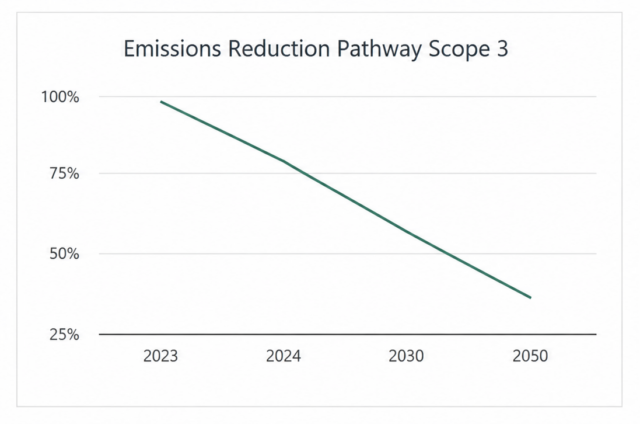
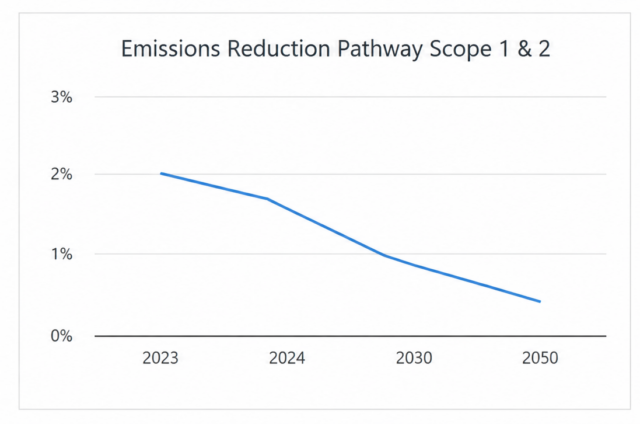
The findings were consolidated into an emissions reduction scenario for 2030 and 2050. This provided a clear picture of how emissions could develop as a result of measures already implemented and planned for the future, while highlighting areas where additional action would be required.

The emissions reduction pathway is based on the data available and assumptions made at the time of the project. Future recalculations may result in deviations from the projected emissions trajectories.

The result
of this success story

Vitra now has a reliable basis for making informed decisions about the further development of its climate strategy. The emissions reduction calculations show which measures offer the greatest reduction potential and how they contribute to achieving the company’s climate targets.

At the same time, the analysis provides transparency regarding the actual impact of existing and planned activities. This enables Vitra to systematically monitor its progress towards its 2030 climate targets and net-zero emissions by 2050, while identifying areas requiring further action.

Based on these insights, the company can prioritize the most effective measures within its climate strategy, continuously review progress and proactively address additional emissions reduction needs.

„By supporting our emissions reduction pathway with concrete figures, we were able to refine our targets and prioritize the most important measures. The transparency gained helps us communicate the impact of these measures clearly, both internally and externally.“

– Iris Grzybek, Sustainability Manager, Vitra

Zur
Leistung

Climate strategy & accounting
Innovation & transformation

Decarbonization strategy & transition plan

Do you know your company’s biggest sources of emissions? With a decarbonization strategy, we identify your most important reduction levers, assess the feasibility of measures and develop a clear transition plan. This will make your company fit for the future and meet the requirements of ESRS E1.

Find out more

Let us write your
success story

Our projects show: Sustainable transformation is best achieved together. Let us find out how we can make your project a success. We look forward to hearing from you!