Stay sustainably informed with current developments, expert insights, and deep dives into our industry. Here, you’ll find valuable information to help you identify opportunities and broaden your understanding.

Quick Access:
Focus knowledge
and focus impulses
Climate strategy & accounting
#Knowledge
ETS II: postponement to 2028?
The launch of the European Emissions Trading System ETS II is likely to be postponed until 2028. However, CO₂ pricing remains a key lever of climate policy. What does this mean for companies in Germany and what steps should be taken now? Our blog post summarizes the current situation and shows how you can remain strategically prepared.
The opportunity and risk analysis helps to systematically identify and assessnopportunities and recognize potential risks at an early stage. Keep reading to find out what an opportunity and risk analysis is, why climate risk analysis is an important part of it and what advantages it offers.
ESPR and the Digital Product Passport: What should companies know and do?
The introduction of EU regulations Ecodesign for Sustainable Products Regulation (ESPR) and the Digital Product Passport (DPP) establish new requirements for transparency, recyclability, and product design. Read on to find out exactly what is changing and which products are affected.
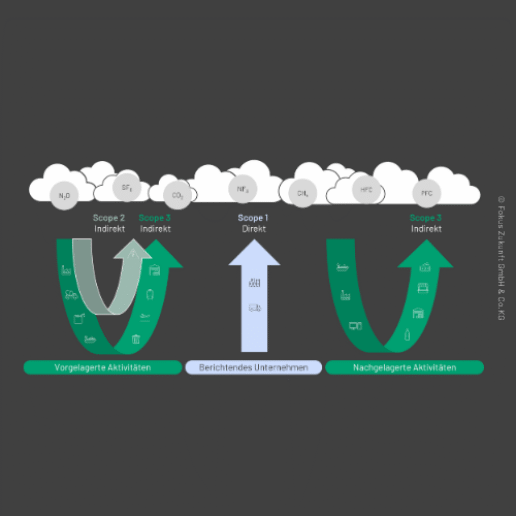
An Overview of the Greenhouse Gas Protocol’s Scopes
The Greenhouse Gas Protocol provides a structure for measuring and comparing greenhouse gas emissions by dividing them into three so-called scopes. But what exactly do these scopes entail? And why is distinguishing between them so crucial for achieving genuine climate targets? The following blog article explores these questions in depth.
6 Questions for Christine Maderspacher on Climate and Emission Reduction Strategies
As part of our Climate Strategy Focus Month, we spoke with Christine Maderspacher. In this interview, she explains what is important for an effective climate strategy, what role energy efficiency plays in this, and how companies can systematically reduce emissions.
Companies in Transition: Understanding Emissions, Developing Strategies, Securing the Future.
In our new blog article, you can find out why greenhouse gas accounting based on the Greenhouse Gas Protocol is often the starting point for corporate sustainability and how you can use it as a basis for successfully developing a decarbonization strategy.
What is a climate strategy and why is it important for companies now?
A targeted climate strategy is also becoming an increasingly important basis for sustainable success for small and medium-sized enterprises. But what exactly is a climate strategy? And why should SMEs take action now?
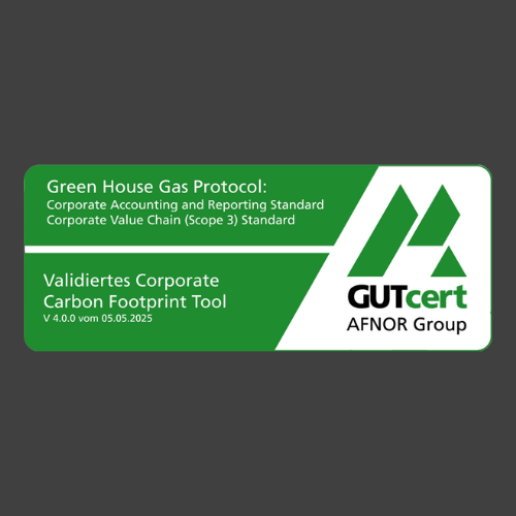
Validation of our accounting methodology by GUTcert
We are proud that our accounting tool for corporate carbon footprints, including Scope 3 materiality screening, has once again been successfully validated by the accredited testing organization GUTcert. Learn more about it here.
Sustainability reporting comparison: VSME, ESRS, and ESRS SMART
The requirements for sustainability reporting are now more closely aligned than ever with a company’s level of maturity and resources. But which reporting method is right for your company?
4 questions for Thomas Ungefug on the topic of circular economy
As part of our circular economy focus month, we spoke with Thomas Ungefug, Senior Sustainability Consultant at Fokus Zukunft. In this interview, he explains why the shift from linear to circular is so urgently needed—and where the greatest potential for innovation and sustainability lies.
The circular economy: sustainability and innovation in harmony
The circular economy combines growth and environmental protection, closes material cycles and uses resources efficiently. Find out how companies can reduce costs and open up new markets as a result.
How companies can use sustainability strategically
The new WMO Report 2024 shows the alarming developments of climate change. However, these also offer companies opportunities: implementing sustainable strategies, exploiting innovation potential and operating successfully in the long term.
EU Omnibus Proposal – New momentum in the discussion on CSRD and CSDDD (as of October 2025)
The Omnibus Regulation plans far-reaching changes to the CSRD, CSDDD, CBAM and EU taxonomy. In this article, we summarize the most important changes, outline the next steps and give you a clear recommendation for action.
What is the difference between these assessments? Here you can find out how you can differentiate between CO₂ accounting and life cycle assessments, where the challenges lie and where there is a need for action.
Terms such as CCF and PCF play a central role in corporate sustainability. But what do they mean in concrete terms and how can companies benefit from the calculations? Find out here.