#Interview
Climate strategy & accounting

6 Questions for Christine Madersbacher on Climate and Emission Reduction Strategies

Info about the article

Author
Christina Schäferkord, Christine Maderspacher
Article from
14.07.2025
Updated on
05.12.2025
Approximate reading time
minutes
Share article

“A climate strategy is not a one-off product that can be completed quickly, but rather a continuous process.”

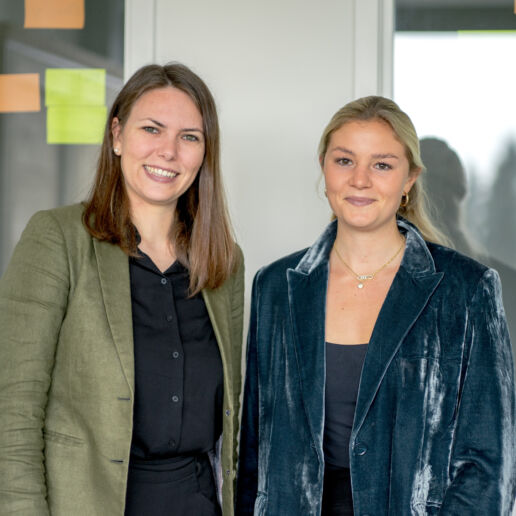
As part of our focus month on climate strategy, we spoke with Christine Maderspacher, Senior Sustainability Consultant at Fokus Zukunft. She and her team support small and medium-sized enterprises on their path to implementing climate-conscious business practices, through CO₂ accounting, strategy development and concrete action planning. In this interview she explains what really matters in establishing an effective climate strategy, the important role energy efficiency plays, and how companies can systematically reduce emissions.

Many companies already have a rough idea of what climate protection entails. In your opinion, what makes a climate strategy truly effective and feasible?

The first step is always to analyze the current situation. This involves compiling figures and data from all areas of the company in order to derive their corresponding CO₂ emissions. This assessment serves as the basis for a climate strategy. It is therefore extremely important that the assessment is based on valid data and also includes all areas of the company. Only then can you get a meaningful picture of the biggest emission drivers and thus the areas with greatest potential for reducing CO₂ emissions in your business.

Once data is collected, the next step is to define savings targets and develop associated measures. It is important to think and act with a long-term perspective. A climate strategy is not a one-off product that can be completed quickly, but rather a continuous process.

Where is the greatest untapped potential for reducing emissions through energy efficiency in small and medium-sized enterprises?

That depends very much on the industry. The manufacturing sector often consumes enormous amounts of electricity or gas to operate its plants and machinery. That is where the potential for savings is naturally greatest. The quickest way to reduce emissions is to switch to green electricity. However, electricity consumption will still remain high and optimizing operations through energy efficiency can save significant amounts of energy, and therefore money.

The situation is often quite different for service companies. Here, business trips or employee commuting can account for a large proportion of the company’s emissions. In this case, it is necessary to raise awareness regarding the importance of employee commuting in order to bring about change.

Which external levers play a key role in the reduction strategy—for example, levers along the supply chain or in cooperation with partners?

In addition to emissions from energy and fuel consumption, we also analyze upstream and downstream processes and their emissions as part of our carbon footprint assessment—in other words, emissions that arise outside the company’s direct sphere of influence. These include logistics, purchased goods and services, and emissions resulting from the use and disposal of sold products. For many companies, collecting data for carbon footprint calculations is not easy and can be quite time-consuming. We support our customers in this area by implementing our pragmatic approach to data collection.

The insights gained from the carbon footprint assessment are very valuable. For example, key CO₂ drivers can be identified on individual logistics routes, in specific raw materials, or even in the disposal of certain products. If a company wants to analyze and optimize the emissions of its products even more precisely, we offer options for this too.

How does CO2 analysis work for products?

CO₂ emissions are analyzed throughout the product life cycle, through an analysis called the product carbon footprint (PCF). A complete PCF begins with raw material extraction and ends at product disposal (from cradle to grave). Depending on the issue or boundary conditions, only a partial analysis, e.g., only up to the factory gate, may be carried out. Depending on the product, it may also make sense to include its function. For the defined boundary, all data on material and energy flows are recorded and the corresponding CO₂ emissions are determined.

If a company wants to calculate product variants itself, an individual CO₂ calculator can even be created for this purpose. This is developed with your specific requirements and constraints in mind, and can be used both in product development and in communication with end customers.

What role does Fokus Zukunft play in this process? How does your team specifically support companies in this regard?

We are your constant companion and advisor throughout this process. We provide support right from the start by helping you define your goals and appropriate scope. Once it is clear which areas and categories of the company or product are to be considered, we help you collect the relevant data. Depending on the industry and size of the company, or even at the product level, this can be a real challenge. To address this, we provide practical advice and work with your company to find pragmatic approaches for the sometimes large and complex data volumes.
Once the assessment is complete, we analyze the results and make suggestions for further action. Sometimes, concrete indications of potential savings can already be derived and attacked at this stage through a jointly developed reduction strategy. We monitor success through regular re-assessments. In general, we are a constant point of contact for our customers for all questions relating to sustainability and climate protection, and we always try to find pragmatic and targeted solutions.


Further contributions

Climate strategy & accounting
Headerbild für den Wissensbibliothek-Artikel zu ETS II
#Knowledge

ETS II: postponement to 2028?

The launch of the European Emissions Trading System ETS II is likely to be postponed until 2028. However, CO₂ pricing remains a key lever of climate policy. What does this mean for companies in Germany and what steps should be taken now? Our blog post summarizes the current situation and shows how you can remain strategically prepared.
Read more
Communication & brand
Hier sind die GutCert Logos zu sehen, die die Erfassungsmaske sowie das Bilanzierungstool von Fokus Zukunft verifizieren.
#Knowledge

The circular economy: sustainability and innovation in harmony

The circular economy combines growth and environmental protection, closes material cycles and uses resources efficiently. Find out how companies can reduce costs and open up new markets as a result.
Read more
Sustainability strategy
Hier sind die GutCert Logos zu sehen, die die Erfassungsmaske sowie das Bilanzierungstool von Fokus Zukunft verifizieren.
#Knowledge

The circular economy: sustainability and innovation in harmony

The circular economy combines growth and environmental protection, closes material cycles and uses resources efficiently. Find out how companies can reduce costs and open up new markets as a result.
Read more
Sustainability strategy
Headerbild für den Wissensbibliothek-Artikel "Chancen- und Risikoanalyse – Risiken erkennen, Chancen nutzen, Kosten vermeiden"
#Knowledge

Opportunity & risk analysis – recognizing risks, taking advantage of opportunities

The opportunity and risk analysis helps to systematically identify and assessnopportunities and recognize potential risks at an early stage. Keep reading to find out what an opportunity and risk analysis is, why climate risk analysis is an important part of it and what advantages it offers.
Read more
Innovation & transformation
Headerbild für den Wissensbibliothek-Artikel "Die Scopes des Greenhouse Gas Protocol verständlich erklärt"
#Knowledge

ESPR and the Digital Product Passport: What should companies know and do?

The introduction of EU regulations Ecodesign for Sustainable Products Regulation (ESPR) and the Digital Product Passport (DPP) establish new requirements for transparency, recyclability, and product design. Read on to find out exactly what is changing and which products are affected.
Read more
Climate strategy & accounting
Dieser Grafik zeigt die Einteilung der Treibhausgasemissionen in Scopes
#Knowledge

An Overview of the Greenhouse Gas Protocol’s Scopes

The Greenhouse Gas Protocol provides a structure for measuring and comparing greenhouse gas emissions by dividing them into three so-called scopes. But what exactly do these scopes entail? And why is distinguishing between them so crucial for achieving genuine climate targets? The following blog article explores these questions in depth.
Read more
Climate strategy & accounting
Innovation & transformation
Headerbild für den Wissensbibliothek-Artikel "Was ist eine Klimastrategie und warum ist sie für Unternehmen jetzt wichtig?"
#Knowledge

Companies in Transition: Understanding Emissions, Developing Strategies, Securing the Future.

In our new blog article, you can find out why greenhouse gas accounting based on the Greenhouse Gas Protocol is often the starting point for corporate sustainability and how you can use it as a basis for successfully developing a decarbonization strategy.
Read more
Climate strategy & accounting
Headerbild für den Wissensbibliothek-Artikel ""
#Knowledge

What is a climate strategy and why is it important for companies now?

A targeted climate strategy is also becoming an increasingly important basis for sustainable success for small and medium-sized enterprises. But what exactly is a climate strategy? And why should SMEs take action now?
Read more
Climate strategy & accounting
Hier sind die GutCert Logos zu sehen, die die Erfassungsmaske sowie das Bilanzierungstool von Fokus Zukunft verifizieren.
#Knowledge

Validation of our accounting methodology by GUTcert

We are proud that our accounting tool for corporate carbon footprints, including Scope 3 materiality screening, has once again been successfully validated by the accredited testing organization GUTcert. Learn more about it here.
Read more