Headerbild für den Wissensbibliothek-Artikel "Green Claims im DACH-Raum: Was die EmpCo und das Schweizer UWG für Unternehmen bedeuten"
#Knowledge
Climate strategy & accounting

Create your CCF with software support:

Our partnership with Carbon+Alt+Delete

Info about the article

Author
Julia Scherbaum, Julia Jahn
Article from
14.08.2026
Updated on
17.08.2026
Approximate reading time
minutes
Share article

Why the Corporate Carbon Footprint Is Becoming Increasingly Important for Companies

For many companies, the Corporate Carbon Footprint (CCF) has long been more than a voluntary climate action measure. It provides transparency on a company’s greenhouse gas emissions and therefore forms an important basis for a well-founded climate strategy. At the same time, it helps companies meet customer and supplier requirements, prepare sustainability reports, and create a reliable basis for management decision-making.

Companies that understand their own emissions can identify key emission drivers, develop targeted reduction measures, and make progress measurable. At the same time, expectations from investors, business partners, and regulatory requirements are increasing. As a result, a robust carbon footprint is becoming an increasingly established standard.

There is no single approach that is right for every Corporate Carbon Footprint. Depending on a company’s size, complexity, and specific requirements, software-supported carbon accounting may be the most suitable option, while in other cases a more individually tailored calculation can offer clear advantages.

Why We Work with Carbon+Alt+Delete

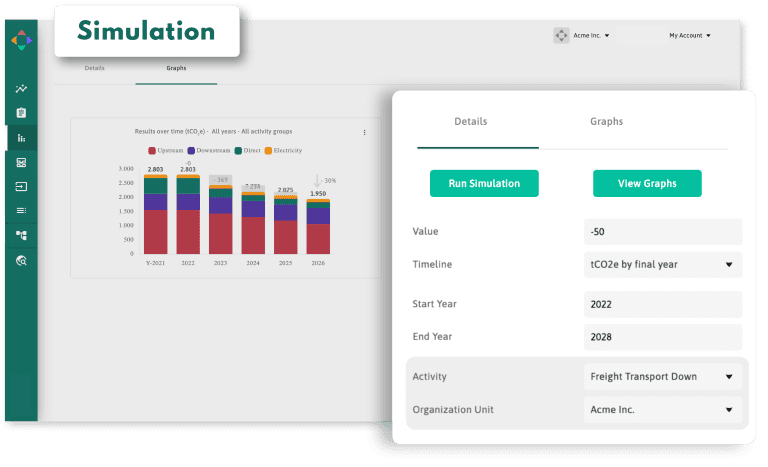
To make standardisable carbon accounting processes more efficient, we work with the Carbon+Alt+Delete software solution. Carbon+Alt+Delete supports the digitalisation of key steps in the carbon accounting process. Digital data collection, automated calculations, emission factors, and structured workflows can reduce the effort involved, particularly for recurring carbon footprints. This makes carbon accounting more efficient while ensuring that results remain transparent and auditable. The platform is based on recognised standards such as the Greenhouse Gas Protocol and supports the carbon accounting process from data collection through to reporting.

For us, the software is therefore an important component in making suitable carbon accounting projects more standardised and efficient in the future. At the same time, individually tailored carbon footprints remain an important part of our services wherever a company’s specific requirements call for them.
The Benefits for Our Clients

1. Faster and More Efficient Carbon Footprints
Digital data collection, automated calculations, and intelligent support in assigning emission factors simplify the creation and updating of carbon footprints.

For our clients, this means:

  • shorter project timelines
  • less internal effort
  • faster availability of reliable results

2. High Data Quality and Compliance
The platform is designed to enable transparent and auditable carbon accounting. It follows established standards such as the Greenhouse Gas Protocol and ISO 14064-1.

As a result, our clients benefit from:

  • greater data reliability and transparency
  • reliable results for internal and external stakeholders
  • a solid basis for sustainability reporting and audits

3. Transparent Insights into Emission Drivers
A carbon footprint is particularly valuable when it leads to concrete opportunities for action. Carbon+Alt+Delete supports the systematic analysis of emission sources and helps identify the key drivers of a company’s emissions.

Our clients benefit from:

  • prioritised areas for action
  • targeted reduction measures
  • well-founded decisions based on reliable data

4. Support with Regulatory Requirements
Requirements for sustainability and climate reporting are continuing to increase. By systematically collecting and documenting relevant emissions data, we work with our clients to create a solid basis for future reporting obligations and sustainability requirements.

5. A Basis for Future-Proof Climate Strategies
The platform not only supports emissions calculation, but also the development of scenarios and the identification of measures on the path towards net-zero targets.

As a result, our clients can:

  • define climate targets on a sound basis
  • measure progress transparently
  • use sustainability as a competitive advantage

Software-Supported or Individual: Which Approach Is the Right Fit?

Not every carbon footprint comes with the same requirements. That is why we work with our clients to determine which accounting approach best fits their specific situation.

Software-supported carbon accounting with Carbon+Alt+Delete is particularly suitable for companies that:

  • are calculating their Corporate Carbon Footprint for the first time,
  • regularly prepare carbon footprints,
  • are preparing sustainability reports,
  • need to meet customer requirements for climate data,
  • want to develop or track emission reduction targets,
  • manage multiple sites or complex supply chains.

Our medium-sized clients with increasing reporting requirements benefit in particular. For recurring carbon footprints, standardised digital processes can also help reduce the workload over the long term.

At the same time, there are cases where an individually prepared carbon footprint remains the more suitable or necessary approach. This includes, for example, carbon footprints prepared in connection with BAFA funding or projects that require a high degree of customisation. In these cases, specific company structures and individual requirements can be taken into account more precisely. A professional software solution is also not always necessary for very small companies with only a few emission sources and limited documentation requirements. For these companies, we offer simplified calculation approaches.

More Than Software: Combining Technology and Consulting

Carbon+Alt+Delete expands the options available within our CCF accounting services. In software-supported projects, the platform handles large parts of the calculation logic and structures the carbon accounting process. We complement this with our expertise in sustainability strategy, decarbonisation, ESG management, and regulatory requirements. Where a higher degree of customisation is required, we continue to prepare carbon footprints using an appropriately adapted approach. This allows us to choose between standardised digital processes and individual accounting approaches depending on the specific situation.

For our clients, this means they do not simply receive a software solution, but a carbon accounting approach tailored to their requirements – combined with expert interpretation of the results and the identification of meaningful next steps.

To
summarize

Our partnership with Carbon+Alt+Delete complements our CCF services with an efficient, software-supported solution. At the same time, we continue to provide individually prepared carbon footprints for specific requirements, a high degree of customisation, or in connection with BAFA funding.

This allows us to select the carbon accounting approach that best fits the respective company and use case. Regardless of the chosen approach, the objective remains the same: to create a reliable data basis, identify key emission drivers, and enable well-founded decisions for the further development of the climate strategy.

Would you like to learn more about how Fokus Zukunft can support you with your CCF?

Explore our service

Further contributions

Climate strategy & accounting
Headerbild für den Wissensbibliothek-Artikel "Dekarbonisierung wirtschaftlich bewerten: So entsteht ein belastbarer Business Case"
#Knowledge

Making Your Climate Strategy Visible: Creating Transparency and Building Trust

A well-founded climate strategy provides the foundation – but effective communication is what makes targets, measures and progress visible. How can companies engage employees, build trust with stakeholders and meet the requirements of the EmpCo Directive at the same time?
Read more
Climate strategy & accounting
Headerbild für den Wissensbibliothek-Artikel "Monetär oder aktivitätsbasiert? Warum die Methode über die Aussagekraft Ihrer CO₂-Bilanz entscheidet"
#Knowledge

Decarbonization: Building a Robust Business Case

Which decarbonization measures make economic sense and which should be prioritized? This article shows how companies can compare investments on a sound basis, factor in CO₂ costs and regulatory developments, and build a robust business case.
Read more
Climate strategy & accounting
Headerbild für den Wissensbibliothek-Artikel "Nicht jede co₂e-Frage braucht dieselbe Datentiefe"
#Knowledge

Monetary or activity-based carbon footprint?

Monetary data provides a quick entry point into carbon accounting. But for major emission sources, it quickly reaches its limits. Our article explains when activity data becomes essential – and why the calculation method determines what you can later derive from your carbon footprint.
Read more
Climate strategy & accounting
Headerbild für den Wissensbibliothek-Artikel "CO₂-Bilanz erstellt: So leiten Unternehmen Ziele und Maßnahmen ab"
#Knowledge

Not Every CO₂e Question Requires the Same Level of Data Detail

While estimates or average values are often sufficient for initial insights, more detailed data is needed for specific decisions and emission reduction measures. Our article uses typical questions to show which level of data detail makes sense in which situations – and where the additional effort required for data collection really pays off.
Read more
Climate strategy & accounting
Headerbild für den Wissensbibliothek-Artikel "Klimaschutzbeiträge glaubwürdig und EmpCo-konform kommunizieren"
#Knowledge

CO₂ footprint completed: How companies can derive targets and actions

The CO₂ footprint is complete – but what comes next? The key is not only to document emissions data, but to use it to set clear priorities, define suitable climate targets and derive concrete measures. In this article, we show which steps can help companies turn transparency into a sound basis for decision-making.
Read more
Communication & brand
Headerbild für den Wissensbibliothek-Artikel "EmpCo-Altbestände: Gibt es eine offizielle Abverkaufsfrist?"
#Knowledge

Communicating Climate Contributions Credibly and in Line with EmpCo

The EmpCo Directive significantly changes the requirements for climate-related claims. This article explains how climate contributions can be communicated transparently, the role of Contribution Claims, and what companies should consider to ensure credible climate communication going forward
Read more
Bild der Fokus Zukunft Direktorinnen Janina Lang und Lena Scharr.
#Interview

10 Years of “Fokus Zukunft”: 5 Questions for Janina Lang & Lena Scharr

To mark the 10th anniversary of Fokus Zukunft, our directors, Janina Lang and Lena Scharr, discuss how sustainability has evolved, the milestones that have shaped the company, and what will be important in the future.
Read more
Communication & brand
Headerbild für den Wissensbibliothek-Artikel "CCF softwaregestützt erstellen: Unsere Partnerschaft mit Carbon+Alt+Delete"
#Knowledge

EmpCo Old Stock: Is There an Official Sell-Through Period?

What happens from 27 September 2026 to goods, packaging and labels that have already been produced and contain sustainability claims? The CPC Common Understanding provides guidance on how authorities should deal with genuine transitional situations and which measures companies should consider now.
Read more
Innovation & transformation
Headerbild für den Wissensbibliothek-Artikel "CCF softwaregestützt erstellen: Unsere Partnerschaft mit Carbon+Alt+Delete"
#Knowledge

Digital Product Passport: Creating the Right Conditions for Implementation Now

The Digital Product Passport is becoming a concrete reality – and for companies, preparation starts long before the passport itself. What matters is whether product data, responsibilities and processes are already set up effectively. Find out what is becoming important now and how companies can get started.
Read more
Communication & brand
Headerbild für den Wissensbibliothek-Artikel "Muss der Nachhaltigkeitsbericht Green Claims/EmpCo konform sein?"
#Knowledge

What EmpCo and the Swiss Unfair Competition Act (UWG) Mean for Companies

Many companies are no longer directly subject to CSRD reporting requirements due to the Omnibus package. But does that really mean sustainability reporting is losing relevance? This article shows why voluntary reporting creates orientation right now — for customer requests, banks, tenders and better internal decision-making.
Read more