#Interview
Innovation & transformation
“The circular economy is not simply about increasing the proportion of recycled materials—it is an opportunity to completely rethink products and solutions.”
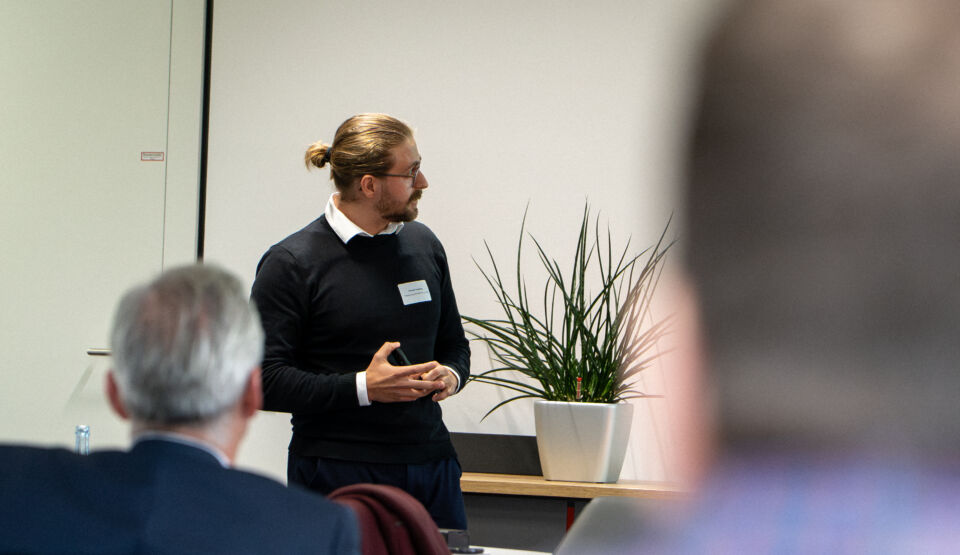
As part of our circular economy focus month, we spoke with Thomas Ungefug, Senior Sustainability Consultant at Fokus Zukunft. He and his team support companies on their journey toward circular business models and work with them to develop decarbonization strategies. He is well aware of the opportunities of transitioning to a circular economy, but also obstacles on the path there. In this interview, he explains why the shift from a linear to circular economy is so urgently needed—and where the greatest potential for innovation and sustainability lies.
The main difference is that the linear economy is in essence a one-way road from extraction to disposal. We extract raw materials, use them to make products, and then throw them away after use – embodying the mentality of sell and forget. In most cases, the resources are irretrievably lost at disposal.
The circular economy, on the other hand, aims to keep raw materials and products in constant circulation, aiming to preserve the value of raw materials endlessly, by recycling products after they have been used for as long as possible. To stick with the previous comparison, if a linear economy is a one-way road then a circular economy is a roundabout.
There are many reasons for this. First and foremost, our resources on this planet are limited. This is also a problem from an economic perspective in the long term. Many products contain finite raw materials that will become increasingly scarce in the coming years. Even simple raw materials such as copper are in high demand due to the energy and mobility transition.
Another reason is the problematic side effects of the linear economy on ecosystems and nature. Two-thirds of all environmental damage is caused by the use of materials. This means that negative impacts ranging from CO₂ emissions, to biodiversity loss, or water scarcity, are all primarily caused by the production and manufacture of raw materials and products by our linear economy. The circular economy is the concrete alternative here: the economy can be profitable while decoupling growth from resource consumption and negative environmental impacts. In other words, it is a green model for long-term growth on a planet with finite resources.
The greatest opportunities lie in the innovation and growth potential of circular business models. After all, the circular economy is not only about increasing the proportion of recycled materials in procurement. Rather, it is an opportunity to rethink products or solutions using the R principles of the circular economy.
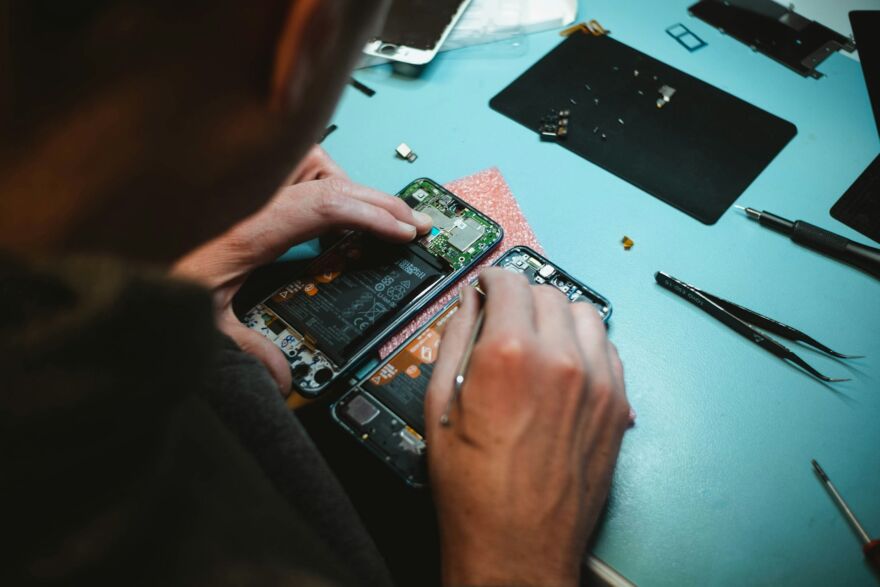
Each of these principles – reuse, refurbish, remanufacturing, repair, to name a few—are potential new business areas and forms of value creation for companies. The beauty of it is that this represents a huge opportunity, especially for the German economy, where many companies focus on high-quality products. After all, quality – alongside other aspects of circular design – is a powerful enabler for profitable, circular business models.
Why is that? The business models in a circular economy are based on longevity and pricing performance rather than quantity (as in traditional business administration). The principle of reuse or resale works best when the resale value is high due to product quality. When other principles such as repair, refurbishment, or remanufacturing are added, the costs of recycling decrease.
In concrete terms, this means that the combination of high residual value after the first life cycle and low reconditioning costs is essential for the profitability of such models. Of course, there are other aspects to consider, such as the choice of materials and the general reconditionability, recyclability, and reparability of products.
The expansion of the circular economy therefore offers companies the opportunity to further enhance their quality USP, set themselves apart from the competition, and offer a competitive alternative to cheap disposable goods. In addition to these business model potentials, there are other advantages such as cost savings through resource efficiency or greater resilience in the supply chain – as the company’s own products become a resource for the future through end-of-life management.
But of course, there are also many challenges involved in implementing this transformation. Many companies have lots of ideas when it comes to implementing “circular” aspects, but lack when it comes to “economic” aspects. They often overlook essential components such as stakeholder involvement, thinking in terms of value creation networks, cost calculations across multiple life cycles, and generating clear customer benefits; all well-known hurdles on the path to a circular economy.
The customer perspective is particularly crucial. The question is: How can circular solutions be developed from the outset to meet genuine customer needs in order to achieve acceptance in the market? As with any new business model development, the most important success factor is involving customers in pilot processes as a “reality check” and learning situation. What advantage does a circular product have over a conventional, linear one? Are there new incentives for use? Are needs better met—or does this possibly create additional costs for users?
The implementation of a circular economy should not be thought of as something that can be simply switched on or off. It is a lengthy process involving many iterations that must be continuously developed.
An important aspect is the distinction between improvement and innovation. Most companies start with initial understandings of the circular economy based entirely on recycling — they may make statements like: “I will increase the recycling share of my raw materials” or “I will focus on the recyclability of my products.” This is not wrong, but ultimately only an improvement on the existing model—and achieves only a very small part of the potential that comes with innovation.
What’s more, recycled material is typically still more expensive than virgin material. This often results in a pseudo-circular economy, as the products made from recycled materials rarely undergo a second life cycle in the same application due to increased costs. Most recycling processes are not only costly but also do not maintain the quality of the material—this leads to downcycling, because material value is lost and new virgin material has to be added.
In order to understand the circular economy as a genuine innovation, it is necessary to have a comprehensive understanding of its potential—in other words, to know where R principles such as Rethink, Reuse, Repair, Refurbishment, or Remanufacturing can be meaningfully applied. This works well with a material flow analysis of one’s own value chain—including all stakeholders.
When applying the R principles, it quickly becomes clear how many connections there are—and that recycling is actually only a small part of what is possible. The real potential lies in the parallel development of a new business model that benefits from closed cycles right from the start. This includes reverse logistics, reprocessing, and the opportunity to generate profits over multiple life cycles.
Even if this seems complex at first, the first steps often reveal the low-hanging fruit. Once a use case with high potential has been identified, an iterative learning process can begin on a small scale. Only then can the important lessons be learned on the path to a circular economy.