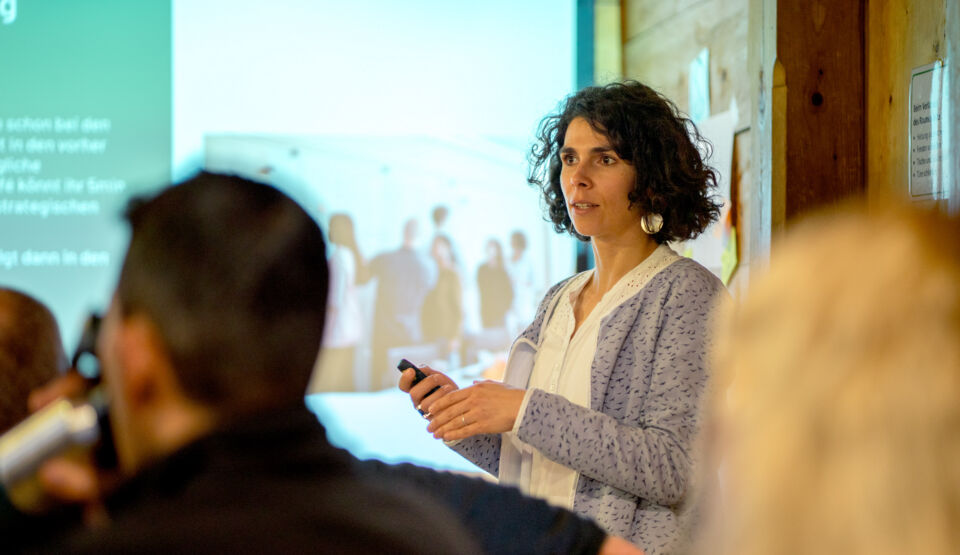
Bild von Sibylle Zavala während eines Vortrags.
#Interview
Sustainability strategy

4 Questions for… Sibylle Zavala on Climate Risk Analysis

Info about the article

Author
Christina Schäferkord, Sibylle Zavala
Article from
17.11.2025
Updated on
17.08.2026
Approximate reading time
minutes
Share article

“Climate risk analyses, however, are increasingly becoming a strategic management tool because they reveal where business models, locations, or supply chains are vulnerable.”

As part of our “Opportunities Through Climate Risk Analysis” focus month, we spoke with Sibylle Zavala. She and her team help companies systematically identify and assess climate risks and translate them into strategic decisions—with the goal of building resilience and ensuring future viability.

In this interview, she explains what really matters in climate risk analysis, what challenges companies typically face in this process, and how opportunities and risks can not only be identified but also strategically leveraged.

In your view, what are the biggest challenges in conducting a climate risk analysis in companies — especially in small and medium-sized enterprises?

One of the biggest challenges is that while many companies recognize the importance of climate risks, they don’t know exactly how to get started in practice. The issue is less a lack of will and more a lack of concrete starting points, clear responsibilities, and practical methods.

At the same time, data resources and time are scarce, and regulatory requirements such as the CSRD seem complex and abstract. Added to this is the fact that climate risks are often not perceived as traditional business risks and are therefore rarely integrated into existing risk management or decision-making processes.

Finally, there is the communication hurdle: Often, there is no clear translation of the analysis results into business language—that is, in terms of concrete impacts on locations and processes. Without this connection to day-to-day business operations, the topic remains theoretical and finds little resonance internally.

How can physical and transitional climate risks be specifically identified and assessed—and what methods or tools do you recommend for this?

To specifically identify and assess physical and transitional climate risks, I recommend a structured approach—such as using the Task Force on Climate-related Financial Disclosures (TCFD) methodology or ISO standards 14090 and 14091.

Physical risks arise from direct climate impacts such as heat, heavy rain, or storms; transitional risks stem from political, economic, and technological changes—for example, new regulations, carbon pricing, or shifts in customer purchasing decisions.

In practice, a step-by-step approach has proven effective: first, conduct qualitative assessments with subject matter experts, then evaluate risks based on probability of occurrence and potential damage.

As part of the scenario analysis, various future scenarios are simulated to identify relevant risks based on climatic conditions. Building on this, resilience is assessed—that is, all measures already being implemented to make the business model, locations, and supply chains resilient or adaptable are identified. Finally, gaps and areas requiring action are highlighted.

In some cases, climate risk analyses can be generated at the push of a button using software; however, these usually cover only individual aspects. Individual assessments, on the other hand, take into account existing measures and the feasibility of necessary adjustments.

What role does climate risk analysis play in strategic corporate development, and how can it help strengthen resilience?

In some cases, climate risk analyses are still viewed as a requirement for regulatory compliance—such as the EU Taxonomy or CSRD-compliant sustainability reports—or as an issue that lies far in the future and has no immediate relevance. However, climate risk analyses are increasingly becoming a strategic management tool because they reveal where business models, locations, or supply chains are vulnerable.

Building on this, targeted measures can be derived—for example, investments in more resilient buildings or processes, adjustments to workflows, or new partnerships. At the same time, opportunities arise: by identifying risks early on, companies can avoid costly repairs or outages, streamline processes, or develop innovative products. Thus, a climate risk analysis supports strategic planning and helps position companies to be more sustainable in the long term.

How can companies ensure that their climate risk analysis is not just a one-time exercise, but is continuously refined?

In my previous answers, I have tried to highlight the importance of climate risk analysis for corporate strategy. It is important not to view the results in isolation, but to embed them in existing business processes. This means, for example, regularly updating the analysis in consultation with functional departments, integrating the results into routine risk management, strategic planning, and investment decisions—and, above all, clearly assigning responsibilities.

In my experience, when companies identify vulnerabilities and prioritize areas for action during the first round of analysis, it becomes natural to repeat the climate risk analysis on a regular basis. This gradually increases resilience to climate-related risks, while at the same time allowing companies to identify new opportunities and benefit from them in the long term.

Further contributions

Climate strategy & accounting
#Knowledge

Create your CCF with software support: Our partnership with Carbon+Alt+Delete

Fokus Zukunft is now a partner of Carbon+Alt+Delete. In our blog, we explain what the partnership is about, why we are expanding our services to include software-supported carbon accounting, and what benefits this creates for you.
Read more
Climate strategy & accounting
Headerbild für den Wissensbibliothek-Artikel zu ETS II
#Knowledge

ETS II: postponement to 2028?

The launch of the European Emissions Trading System ETS II is likely to be postponed until 2028. However, CO₂ pricing remains a key lever of climate policy. What does this mean for companies in Germany and what steps should be taken now? Our blog post summarizes the current situation and shows how you can remain strategically prepared.
Read more
Communication & brand
Hier sind die GutCert Logos zu sehen, die die Erfassungsmaske sowie das Bilanzierungstool von Fokus Zukunft verifizieren.
#Knowledge

Why companies should take voluntary reporting seriously

Many companies are no longer directly subject to CSRD reporting requirements due to the Omnibus package. But does that really mean sustainability reporting is losing relevance? This article shows why voluntary reporting creates orientation right now — for customer requests, banks, tenders and better internal decision-making.
Read more
Sustainability reporting
Communication & brand
Hier sind die GutCert Logos zu sehen, die die Erfassungsmaske sowie das Bilanzierungstool von Fokus Zukunft verifizieren.
#Knowledge

Why companies should take voluntary reporting seriously

Many companies are no longer directly subject to CSRD reporting requirements due to the Omnibus package. But does that really mean sustainability reporting is losing relevance? This article shows why voluntary reporting creates orientation right now — for customer requests, banks, tenders and better internal decision-making.
Read more
Sustainability reporting
Hier sind die GutCert Logos zu sehen, die die Erfassungsmaske sowie das Bilanzierungstool von Fokus Zukunft verifizieren.
#Knowledge

Why companies should take voluntary reporting seriously

Many companies are no longer directly subject to CSRD reporting requirements due to the Omnibus package. But does that really mean sustainability reporting is losing relevance? This article shows why voluntary reporting creates orientation right now — for customer requests, banks, tenders and better internal decision-making.
Read more
Sustainability reporting
Hier sind die GutCert Logos zu sehen, die die Erfassungsmaske sowie das Bilanzierungstool von Fokus Zukunft verifizieren.
#Knowledge

Why companies should take voluntary reporting seriously

Many companies are no longer directly subject to CSRD reporting requirements due to the Omnibus package. But does that really mean sustainability reporting is losing relevance? This article shows why voluntary reporting creates orientation right now — for customer requests, banks, tenders and better internal decision-making.
Read more
Sustainability reporting
Hier sind die GutCert Logos zu sehen, die die Erfassungsmaske sowie das Bilanzierungstool von Fokus Zukunft verifizieren.
#Knowledge

Why companies should take voluntary reporting seriously

Many companies are no longer directly subject to CSRD reporting requirements due to the Omnibus package. But does that really mean sustainability reporting is losing relevance? This article shows why voluntary reporting creates orientation right now — for customer requests, banks, tenders and better internal decision-making.
Read more
Sustainability reporting
Hier sind die GutCert Logos zu sehen, die die Erfassungsmaske sowie das Bilanzierungstool von Fokus Zukunft verifizieren.
#Knowledge

Why companies should take voluntary reporting seriously

Many companies are no longer directly subject to CSRD reporting requirements due to the Omnibus package. But does that really mean sustainability reporting is losing relevance? This article shows why voluntary reporting creates orientation right now — for customer requests, banks, tenders and better internal decision-making.
Read more
Sustainability reporting
Hier sind die GutCert Logos zu sehen, die die Erfassungsmaske sowie das Bilanzierungstool von Fokus Zukunft verifizieren.
#Knowledge

Why companies should take voluntary reporting seriously

Many companies are no longer directly subject to CSRD reporting requirements due to the Omnibus package. But does that really mean sustainability reporting is losing relevance? This article shows why voluntary reporting creates orientation right now — for customer requests, banks, tenders and better internal decision-making.
Read more
Communication & brand
Hier sind die GutCert Logos zu sehen, die die Erfassungsmaske sowie das Bilanzierungstool von Fokus Zukunft verifizieren.
#Knowledge

The circular economy: sustainability and innovation in harmony

The circular economy combines growth and environmental protection, closes material cycles and uses resources efficiently. Find out how companies can reduce costs and open up new markets as a result.
Read more