#Knowledge
Innovation & transformation

How companies can use sustainability strategically

Sustainability as a lever for resilience, innovation and economic success

Info about the article

Author
Christina Schäferkord
Article from
20.03.2025
Updated on
19.11.2025
Approximate reading time
minutes
Share article

Climate change – a reality that obliges us to act

The new WMO (World Meterological Organization) report “State of the global Climate 2024″ holds up a mirror to us. The consequences of climate change are no longer predictions for the future – they are reality. A look at the latest figures shows the urgent need for action:

  • 2024 was the warmest year on record, with a global average temperature of 1.55 °C above pre-industrial levels.
  • The CO₂ concentration in the atmosphere reached 420 ppm – a new record.
  • Sea levels are rising faster than ever before and the oceans are warming twice as fast as just a few decades ago.
  • Glaciers and polar ice are melting drastically, with massive consequences for water availability and ecosystems.
  • Extreme weather events such as floods, droughts, forest fires and heatwaves cause billions in economic damage.

These developments are alarming, but they also offer companies an opportunity: implement sustainable strategies now to build resilience, exploit innovation potential and operate successfully in the long term.

Why companies should use sustainability as a strategic lever

Climate change is no longer a marginal issue – it has a direct impact on business models and value chains. Companies that strategically anchor sustainability benefit in several ways. There are various focus areas and levers they can apply. Here are our recommendations for action:

Sustainability as an investment in the future

  • Companies with a clear climate strategy secure long-term competitive advantages.
  • Investors and consumers are increasingly focusing on sustainable business models.
  • Conserving resources and adapting to climate change reduce costs and risks in the long term.


From risk to resilience: climate strategies for companies

  • Actively managing climate risks: taking measures at an early stage minimizes weather-related production losses and delivery bottlenecks.
  • Building sustainable supply chains: Transparency and climate-friendly processes strengthen resilience.
  • Using the circular economy: Recycling, reuse and resource-conserving processes open up new economic potential.


Beyond Compliance: Moving more together
  • Understanding regulatory requirements as a minimum standard: Sustainability is more than a compulsory program.
  • Cross-industry cooperation can produce innovative solutions.
  • Promoting climate innovation: Investments in renewable energies, CO₂ reductions and new technologies pay off.

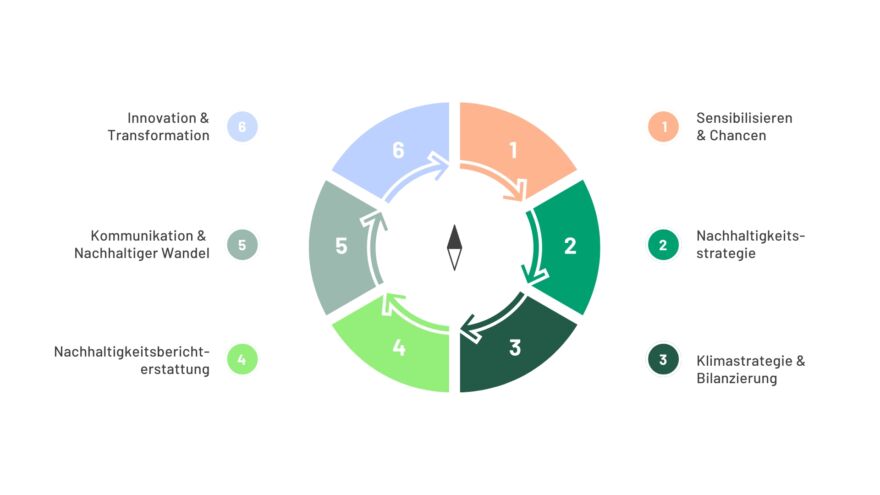
Sustainable transformation with our sustainability navigator

Companies are at different points in their sustainability journey. While some are already working specifically on CO₂ reduction and the circular economy, others are still looking for the right entry point into the green transformation.

As a holistic consultancy, we accompany companies on this journey – from strategy development to practical implementation. Our sustainability navigator serves as a guide and shows individual development opportunities along the entire customer journey of sustainability. In this way, we help companies to find tailor-made solutions and efficiently shape sustainable change.

Das Bild zeigt den Fokus Zukunft Nachhaltigkeitsnavigator.

Our conclusion: act now to remain fit for the future

Climate change is no longer an abstract threat – it is a reality. Companies that act now will benefit in more ways than one:

  • They ensure their economic stability.
  • They reduce long-term risks.
  • They position themselves as responsible players in a changing market.

Sustainability is no longer a “nice-to-have” – it is a strategic success factor and the most important lever for a future-proof economy.

Our experts’ assessment: Sustainability as a competitive advantage

“Companies that see sustainability as an opportunity have a clear market advantage. Customers, investors and talent are specifically looking for responsible organizations. Sustainable business models are therefore not just a contribution to climate protection – they are an investment in the entrepreneurial future. We are at a turning point. The question is no longer whether companies will become more sustainable – but how quickly they will actively shape the change.”

– Theresa Janke, sustainability consultant at Fokus Zukunft

Further contributions

Climate strategy & accounting
Headerbild für den Wissensbibliothek-Artikel zu ETS II
#Knowledge

ETS II: postponement to 2028?

The launch of the European Emissions Trading System ETS II is likely to be postponed until 2028. However, CO₂ pricing remains a key lever of climate policy. What does this mean for companies in Germany and what steps should be taken now? Our blog post summarizes the current situation and shows how you can remain strategically prepared.
Read more
Communication & brand
Hier sind die GutCert Logos zu sehen, die die Erfassungsmaske sowie das Bilanzierungstool von Fokus Zukunft verifizieren.
#Knowledge

The circular economy: sustainability and innovation in harmony

The circular economy combines growth and environmental protection, closes material cycles and uses resources efficiently. Find out how companies can reduce costs and open up new markets as a result.
Read more
Sustainability strategy
Hier sind die GutCert Logos zu sehen, die die Erfassungsmaske sowie das Bilanzierungstool von Fokus Zukunft verifizieren.
#Knowledge

The circular economy: sustainability and innovation in harmony

The circular economy combines growth and environmental protection, closes material cycles and uses resources efficiently. Find out how companies can reduce costs and open up new markets as a result.
Read more
Sustainability strategy
Headerbild für den Wissensbibliothek-Artikel "Chancen- und Risikoanalyse – Risiken erkennen, Chancen nutzen, Kosten vermeiden"
#Knowledge

Opportunity & risk analysis – recognizing risks, taking advantage of opportunities

The opportunity and risk analysis helps to systematically identify and assessnopportunities and recognize potential risks at an early stage. Keep reading to find out what an opportunity and risk analysis is, why climate risk analysis is an important part of it and what advantages it offers.
Read more
Innovation & transformation
Headerbild für den Wissensbibliothek-Artikel "Die Scopes des Greenhouse Gas Protocol verständlich erklärt"
#Knowledge

ESPR and the Digital Product Passport: What should companies know and do?

The introduction of EU regulations Ecodesign for Sustainable Products Regulation (ESPR) and the Digital Product Passport (DPP) establish new requirements for transparency, recyclability, and product design. Read on to find out exactly what is changing and which products are affected.
Read more
Climate strategy & accounting
Dieser Grafik zeigt die Einteilung der Treibhausgasemissionen in Scopes
#Knowledge

An Overview of the Greenhouse Gas Protocol’s Scopes

The Greenhouse Gas Protocol provides a structure for measuring and comparing greenhouse gas emissions by dividing them into three so-called scopes. But what exactly do these scopes entail? And why is distinguishing between them so crucial for achieving genuine climate targets? The following blog article explores these questions in depth.
Read more
Climate strategy & accounting
#Interview

6 Questions for Christine Maderspacher on Climate and Emission Reduction Strategies

As part of our Climate Strategy Focus Month, we spoke with Christine Maderspacher. In this interview, she explains what is important for an effective climate strategy, what role energy efficiency plays in this, and how companies can systematically reduce emissions.
Read more
Climate strategy & accounting
Innovation & transformation
Headerbild für den Wissensbibliothek-Artikel "Was ist eine Klimastrategie und warum ist sie für Unternehmen jetzt wichtig?"
#Knowledge

Companies in Transition: Understanding Emissions, Developing Strategies, Securing the Future.

In our new blog article, you can find out why greenhouse gas accounting based on the Greenhouse Gas Protocol is often the starting point for corporate sustainability and how you can use it as a basis for successfully developing a decarbonization strategy.
Read more
Climate strategy & accounting
Headerbild für den Wissensbibliothek-Artikel ""
#Knowledge

What is a climate strategy and why is it important for companies now?

A targeted climate strategy is also becoming an increasingly important basis for sustainable success for small and medium-sized enterprises. But what exactly is a climate strategy? And why should SMEs take action now?
Read more
Climate strategy & accounting
Hier sind die GutCert Logos zu sehen, die die Erfassungsmaske sowie das Bilanzierungstool von Fokus Zukunft verifizieren.
#Knowledge

Validation of our accounting methodology by GUTcert

We are proud that our accounting tool for corporate carbon footprints, including Scope 3 materiality screening, has once again been successfully validated by the accredited testing organization GUTcert. Learn more about it here.
Read more