#Knowledge
Climate strategy & accounting

CO₂ accounting vs. life cycle assessment

Why companies should be familiar with both approaches

Info about the article

Author
Julia Jahn
Article from
06.02.2025
Updated on
19.11.2025
Approximate reading time
minutes
Share article

“Carbon accounting and life cycle assessment are two important tools for gaining clarity about a company’s environmental impact.”

Introduction

Sustainability is no longer just a trend, but a necessity. Companies are under increasing pressure to minimize and record their environmental impact and improve their sustainability strategies. Two important concepts in this context are carbon accounting and life cycle assessment. But what exactly are the differences and why are they relevant for companies?

We passed on precisely these questions to one of our experts – our sustainability consultant with a focus on accounting, Marnie Schmidt.

What is CO2 accounting?

CO₂ accounting, also known colloquially as a “CO₂ footprint”, is a specialized approach that focuses on recording and calculating greenhouse gas emissions. The accounting can be carried out for individual products or the entire company, for example, and provides information on where emissions occur, whether in production, the supply chain or the use of products. In addition to carbon dioxide emissions, other greenhouse gases such as methane (CH₄) and nitrous oxide (N₂O) are also taken into account in accordance with the Kyoto Protocol. These emissions are converted into CO₂ equivalents in order to create a uniform measure for the various greenhouse gases. Targeted reduction measures can be derived from the CO₂ accounting and unavoidable emissions can be compensated for afterwards.

What is life cycle assessment?

Life cycle assessment goes one step further and looks at the entire “environmental footprint”. It includes various impact categories such as water consumption, soil acidification and greenhouse gas emissions, including CO₂ accounting. Life cycle assessment therefore offers a more comprehensive perspective on environmental impacts that go beyond CO₂ emissions.

Why are these balance sheets important?

Both methods give companies a better understanding and more transparency about their environmental impact. While life cycle assessments are not currently mandatory, there is a need for action in the area of carbon accounting. Under the Corporate Sustainability Reporting Directive (CSRD), companies in the EU are obliged to prepare a sustainability report under certain conditions when the CSRD is transposed into German law.

Companies need to understand which areas of their operations have the greatest impact on the climate in order to take effective measures for reduction and compensation. Carbon accounting provides a clear, standardized method for measuring and communicating greenhouse gas emissions both within the company and to external stakeholders.

The limits of life cycle assessment

Although LCA provides a comprehensive view of a company’s environmental impact, there are some challenges that limit its use. One of the biggest difficulties is data availability and quality. There are different metrics and data requirements for each LCA impact category, which makes it difficult to compare and evaluate the results.

As there are already established methods, extensive databases and reporting requirements (CSRD) for carbon accounting, companies and legislators are currently focusing more on this aspect than on life cycle assessment.

Challenges during implementation

The implementation of both types of carbon accounting presents several challenges. A common issue is the availability of necessary data. Many companies do not have this data readily available, as it is not required for day-to-day operations. Another challenge lies in capturing the full value chain. This is especially relevant for companies subject to the CSRD, as they must also account for downstream data, such as logistics, product use, and disposal.

To simplify this process, we recommend an initial baseline assessment for our clients. This helps establish the necessary infrastructure and adapt to new regulations, enabling a more efficient carbon accounting process in the future.

To summarize

CO₂ accounting, with its standardized method and comprehensive databases, offers the opportunity to measure greenhouse gas emissions and derive direct measures to reduce emissions. The annual submission of a CSRD report will become mandatory under certain conditions when the CSRD is transposed into German law.

Life cycle assessment, on the other hand, broadens the perspective and enables companies to consider a wide range of environmental impacts, from water consumption to biodiversity. Due to challenges such as the difficult availability and quality of data, this method is not used as a basis for regulation or action.

However, our forecast is that life cycle assessment will probably play a greater role in the future, especially if new regulations are adopted.

Further contributions

Climate strategy & accounting
Headerbild für den Wissensbibliothek-Artikel zu ETS II
#Knowledge

ETS II: postponement to 2028?

The launch of the European Emissions Trading System ETS II is likely to be postponed until 2028. However, CO₂ pricing remains a key lever of climate policy. What does this mean for companies in Germany and what steps should be taken now? Our blog post summarizes the current situation and shows how you can remain strategically prepared.
Read more
Communication & brand
Hier sind die GutCert Logos zu sehen, die die Erfassungsmaske sowie das Bilanzierungstool von Fokus Zukunft verifizieren.
#Knowledge

The circular economy: sustainability and innovation in harmony

The circular economy combines growth and environmental protection, closes material cycles and uses resources efficiently. Find out how companies can reduce costs and open up new markets as a result.
Read more
Sustainability strategy
Hier sind die GutCert Logos zu sehen, die die Erfassungsmaske sowie das Bilanzierungstool von Fokus Zukunft verifizieren.
#Knowledge

The circular economy: sustainability and innovation in harmony

The circular economy combines growth and environmental protection, closes material cycles and uses resources efficiently. Find out how companies can reduce costs and open up new markets as a result.
Read more
Sustainability strategy
Headerbild für den Wissensbibliothek-Artikel "Chancen- und Risikoanalyse – Risiken erkennen, Chancen nutzen, Kosten vermeiden"
#Knowledge

Opportunity & risk analysis – recognizing risks, taking advantage of opportunities

The opportunity and risk analysis helps to systematically identify and assessnopportunities and recognize potential risks at an early stage. Keep reading to find out what an opportunity and risk analysis is, why climate risk analysis is an important part of it and what advantages it offers.
Read more
Innovation & transformation
Headerbild für den Wissensbibliothek-Artikel "Die Scopes des Greenhouse Gas Protocol verständlich erklärt"
#Knowledge

ESPR and the Digital Product Passport: What should companies know and do?

The introduction of EU regulations Ecodesign for Sustainable Products Regulation (ESPR) and the Digital Product Passport (DPP) establish new requirements for transparency, recyclability, and product design. Read on to find out exactly what is changing and which products are affected.
Read more
Climate strategy & accounting
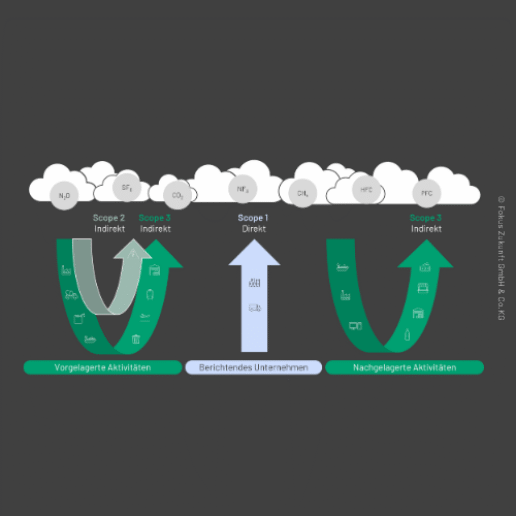
Dieser Grafik zeigt die Einteilung der Treibhausgasemissionen in Scopes
#Knowledge

An Overview of the Greenhouse Gas Protocol’s Scopes

The Greenhouse Gas Protocol provides a structure for measuring and comparing greenhouse gas emissions by dividing them into three so-called scopes. But what exactly do these scopes entail? And why is distinguishing between them so crucial for achieving genuine climate targets? The following blog article explores these questions in depth.
Read more
Climate strategy & accounting
#Interview

6 Questions for Christine Maderspacher on Climate and Emission Reduction Strategies

As part of our Climate Strategy Focus Month, we spoke with Christine Maderspacher. In this interview, she explains what is important for an effective climate strategy, what role energy efficiency plays in this, and how companies can systematically reduce emissions.
Read more
Climate strategy & accounting
Innovation & transformation
Headerbild für den Wissensbibliothek-Artikel "Was ist eine Klimastrategie und warum ist sie für Unternehmen jetzt wichtig?"
#Knowledge

Companies in Transition: Understanding Emissions, Developing Strategies, Securing the Future.

In our new blog article, you can find out why greenhouse gas accounting based on the Greenhouse Gas Protocol is often the starting point for corporate sustainability and how you can use it as a basis for successfully developing a decarbonization strategy.
Read more
Climate strategy & accounting
Headerbild für den Wissensbibliothek-Artikel ""
#Knowledge

What is a climate strategy and why is it important for companies now?

A targeted climate strategy is also becoming an increasingly important basis for sustainable success for small and medium-sized enterprises. But what exactly is a climate strategy? And why should SMEs take action now?
Read more
Climate strategy & accounting
Hier sind die GutCert Logos zu sehen, die die Erfassungsmaske sowie das Bilanzierungstool von Fokus Zukunft verifizieren.
#Knowledge

Validation of our accounting methodology by GUTcert

We are proud that our accounting tool for corporate carbon footprints, including Scope 3 materiality screening, has once again been successfully validated by the accredited testing organization GUTcert. Learn more about it here.
Read more