#Knowledge
Innovation & transformation

How companies can use sustainability strategically

Sustainability as a lever for resilience, innovation and economic success

Info about the article

Author
Christina Schäferkord
Article from
20.03.2025
Updated on
19.11.2025
Approximate reading time
minutes
Share article

Climate change – a reality that obliges us to act

The new WMO (World Meterological Organization) report “State of the global Climate 2024″ holds up a mirror to us. The consequences of climate change are no longer predictions for the future – they are reality. A look at the latest figures shows the urgent need for action:

  • 2024 was the warmest year on record, with a global average temperature of 1.55 °C above pre-industrial levels.
  • The CO₂ concentration in the atmosphere reached 420 ppm – a new record.
  • Sea levels are rising faster than ever before and the oceans are warming twice as fast as just a few decades ago.
  • Glaciers and polar ice are melting drastically, with massive consequences for water availability and ecosystems.
  • Extreme weather events such as floods, droughts, forest fires and heatwaves cause billions in economic damage.

These developments are alarming, but they also offer companies an opportunity: implement sustainable strategies now to build resilience, exploit innovation potential and operate successfully in the long term.

Why companies should use sustainability as a strategic lever

Climate change is no longer a marginal issue – it has a direct impact on business models and value chains. Companies that strategically anchor sustainability benefit in several ways. There are various focus areas and levers they can apply. Here are our recommendations for action:

Sustainability as an investment in the future

  • Companies with a clear climate strategy secure long-term competitive advantages.
  • Investors and consumers are increasingly focusing on sustainable business models.
  • Conserving resources and adapting to climate change reduce costs and risks in the long term.


From risk to resilience: climate strategies for companies

  • Actively managing climate risks: taking measures at an early stage minimizes weather-related production losses and delivery bottlenecks.
  • Building sustainable supply chains: Transparency and climate-friendly processes strengthen resilience.
  • Using the circular economy: Recycling, reuse and resource-conserving processes open up new economic potential.


Beyond Compliance: Moving more together
  • Understanding regulatory requirements as a minimum standard: Sustainability is more than a compulsory program.
  • Cross-industry cooperation can produce innovative solutions.
  • Promoting climate innovation: Investments in renewable energies, CO₂ reductions and new technologies pay off.

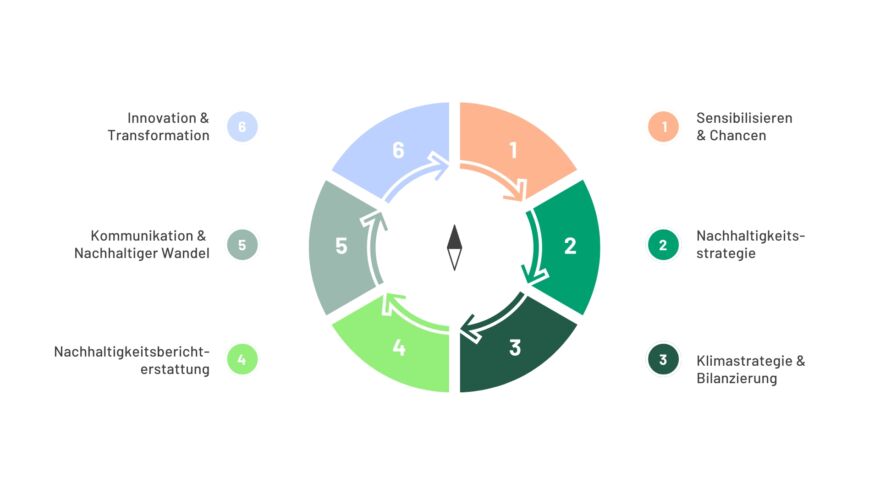
Sustainable transformation with our sustainability navigator

Companies are at different points in their sustainability journey. While some are already working specifically on CO₂ reduction and the circular economy, others are still looking for the right entry point into the green transformation.

As a holistic consultancy, we accompany companies on this journey – from strategy development to practical implementation. Our sustainability navigator serves as a guide and shows individual development opportunities along the entire customer journey of sustainability. In this way, we help companies to find tailor-made solutions and efficiently shape sustainable change.

Das Bild zeigt den Fokus Zukunft Nachhaltigkeitsnavigator.

Our conclusion: act now to remain fit for the future

Climate change is no longer an abstract threat – it is a reality. Companies that act now will benefit in more ways than one:

  • They ensure their economic stability.
  • They reduce long-term risks.
  • They position themselves as responsible players in a changing market.

Sustainability is no longer a “nice-to-have” – it is a strategic success factor and the most important lever for a future-proof economy.

Our experts’ assessment: Sustainability as a competitive advantage

“Companies that see sustainability as an opportunity have a clear market advantage. Customers, investors and talent are specifically looking for responsible organizations. Sustainable business models are therefore not just a contribution to climate protection – they are an investment in the entrepreneurial future. We are at a turning point. The question is no longer whether companies will become more sustainable – but how quickly they will actively shape the change.”

– Theresa Janke, sustainability consultant at Fokus Zukunft

Further contributions

Climate strategy & accounting
Headerbild für den Wissensbibliothek-Artikel "Dekarbonisierung wirtschaftlich bewerten: So entsteht ein belastbarer Business Case"
#Knowledge

Making Your Climate Strategy Visible: Creating Transparency and Building Trust

A well-founded climate strategy provides the foundation – but effective communication is what makes targets, measures and progress visible. How can companies engage employees, build trust with stakeholders and meet the requirements of the EmpCo Directive at the same time?
Read more
Climate strategy & accounting
Headerbild für den Wissensbibliothek-Artikel "Monetär oder aktivitätsbasiert? Warum die Methode über die Aussagekraft Ihrer CO₂-Bilanz entscheidet"
#Knowledge

Decarbonization: Building a Robust Business Case

Which decarbonization measures make economic sense and which should be prioritized? This article shows how companies can compare investments on a sound basis, factor in CO₂ costs and regulatory developments, and build a robust business case.
Read more
Climate strategy & accounting
Headerbild für den Wissensbibliothek-Artikel "Nicht jede co₂e-Frage braucht dieselbe Datentiefe"
#Knowledge

Monetary or activity-based carbon footprint?

Monetary data provides a quick entry point into carbon accounting. But for major emission sources, it quickly reaches its limits. Our article explains when activity data becomes essential – and why the calculation method determines what you can later derive from your carbon footprint.
Read more
Climate strategy & accounting
Headerbild für den Wissensbibliothek-Artikel "CO₂-Bilanz erstellt: So leiten Unternehmen Ziele und Maßnahmen ab"
#Knowledge

Not Every CO₂e Question Requires the Same Level of Data Detail

While estimates or average values are often sufficient for initial insights, more detailed data is needed for specific decisions and emission reduction measures. Our article uses typical questions to show which level of data detail makes sense in which situations – and where the additional effort required for data collection really pays off.
Read more
Climate strategy & accounting
Headerbild für den Wissensbibliothek-Artikel "Klimaschutzbeiträge glaubwürdig und EmpCo-konform kommunizieren"
#Knowledge

CO₂ footprint completed: How companies can derive targets and actions

The CO₂ footprint is complete – but what comes next? The key is not only to document emissions data, but to use it to set clear priorities, define suitable climate targets and derive concrete measures. In this article, we show which steps can help companies turn transparency into a sound basis for decision-making.
Read more
Communication & brand
Headerbild für den Wissensbibliothek-Artikel "EmpCo-Altbestände: Gibt es eine offizielle Abverkaufsfrist?"
#Knowledge

Communicating Climate Contributions Credibly and in Line with EmpCo

The EmpCo Directive significantly changes the requirements for climate-related claims. This article explains how climate contributions can be communicated transparently, the role of Contribution Claims, and what companies should consider to ensure credible climate communication going forward
Read more
Bild der Fokus Zukunft Direktorinnen Janina Lang und Lena Scharr.
#Interview

10 Years of “Fokus Zukunft”: 5 Questions for Janina Lang & Lena Scharr

To mark the 10th anniversary of Fokus Zukunft, our directors, Janina Lang and Lena Scharr, discuss how sustainability has evolved, the milestones that have shaped the company, and what will be important in the future.
Read more
Communication & brand
Headerbild für den Wissensbibliothek-Artikel "CCF softwaregestützt erstellen: Unsere Partnerschaft mit Carbon+Alt+Delete"
#Knowledge

EmpCo Old Stock: Is There an Official Sell-Through Period?

What happens from 27 September 2026 to goods, packaging and labels that have already been produced and contain sustainability claims? The CPC Common Understanding provides guidance on how authorities should deal with genuine transitional situations and which measures companies should consider now.
Read more
Innovation & transformation
Headerbild für den Wissensbibliothek-Artikel "CCF softwaregestützt erstellen: Unsere Partnerschaft mit Carbon+Alt+Delete"
#Knowledge

Digital Product Passport: Creating the Right Conditions for Implementation Now

The Digital Product Passport is becoming a concrete reality – and for companies, preparation starts long before the passport itself. What matters is whether product data, responsibilities and processes are already set up effectively. Find out what is becoming important now and how companies can get started.
Read more
Communication & brand
Headerbild für den Wissensbibliothek-Artikel "Muss der Nachhaltigkeitsbericht Green Claims/EmpCo konform sein?"
#Knowledge

What EmpCo and the Swiss Unfair Competition Act (UWG) Mean for Companies

Many companies are no longer directly subject to CSRD reporting requirements due to the Omnibus package. But does that really mean sustainability reporting is losing relevance? This article shows why voluntary reporting creates orientation right now — for customer requests, banks, tenders and better internal decision-making.
Read more