Headerbild für den Wissensbibliothek-Artikel ""
#Knowledge
Climate strategy & accounting

What is a climate strategy and why is it important for companies?

Info about the article

Author
Christina Schäferkord
Article from
02.12.2025
Updated on
08.12.2025
Approximate reading time
minutes
Share article

Climate protection is no longer an issue that only affects large corporations. Having a targeted climate strategy is becoming increasingly important for small and medium-sized enterprises in establishing a basis for sustainable success. But what exactly is a climate strategy? And why should SMEs in particular take action now?

What is a climate strategy?

A climate strategy is a comprehensive plan that enables a company to record, evaluate, and systematically reduce its greenhouse gas emissions. It identifies effective levers for reducing ecological footprint, such as measures for energy efficiency, the use of renewable energies, and sustainable procurement.

This is not just about environmental protection, but also about economic opportunities: companies that focus on sustainability early on secure competitive advantages, reduce long-term costs, and are better equipped for future legal requirements.

Why is having an effective climate strategy particularly important for SMEs?

SMEs face specific challenges: limited resources, complex supply chains, and often less expertise in the area of sustainability. At the same time, customers, investors, and business partners have growing expectations for greater transparency and climate protection.

A well-thought-out climate strategy helps SMEs because:

  • It provides clarity on the status of their current emissions
  • It identifies specific savings potential and efficiency gains
  • It prepares companies for regulatory requirements
  • It strengthens their market position through evidenced sustainable action
  • It opens up access to funding and investment

First steps toward developing your own climate strategy

The first step in developing a climate strategy is often to calculate your carbon footprint—that is, to quantify your greenhouse gas emissions. This can be done in a simple and practical way and allow you to understand your most important sources of emissions.

A carbon footprint allows company’s to develop concrete measures, such as:

  • Optimization of energy consumption
  • Switches to more climate-friendly materials
  • Promoting sustainable mobility
  • Supply chain integration

To summarize

Climate strategy is not just “nice-to-have” for SMEs, but a crucial building block for future viability and economic success. Now is the right time to act—because those who start early will benefit from competitive advantages, and be well equipped for the challenges of tomorrow.

Further contributions

Climate strategy & accounting
Headerbild für den Wissensbibliothek-Artikel zu ETS II
#Knowledge

ETS II: postponement to 2028?

The launch of the European Emissions Trading System ETS II is likely to be postponed until 2028. However, CO₂ pricing remains a key lever of climate policy. What does this mean for companies in Germany and what steps should be taken now? Our blog post summarizes the current situation and shows how you can remain strategically prepared.
Read more
Communication & brand
Hier sind die GutCert Logos zu sehen, die die Erfassungsmaske sowie das Bilanzierungstool von Fokus Zukunft verifizieren.
#Knowledge

The circular economy: sustainability and innovation in harmony

The circular economy combines growth and environmental protection, closes material cycles and uses resources efficiently. Find out how companies can reduce costs and open up new markets as a result.
Read more
Sustainability strategy
Hier sind die GutCert Logos zu sehen, die die Erfassungsmaske sowie das Bilanzierungstool von Fokus Zukunft verifizieren.
#Knowledge

The circular economy: sustainability and innovation in harmony

The circular economy combines growth and environmental protection, closes material cycles and uses resources efficiently. Find out how companies can reduce costs and open up new markets as a result.
Read more
Communication & brand
Hier sind die GutCert Logos zu sehen, die die Erfassungsmaske sowie das Bilanzierungstool von Fokus Zukunft verifizieren.
#Knowledge

The circular economy: sustainability and innovation in harmony

The circular economy combines growth and environmental protection, closes material cycles and uses resources efficiently. Find out how companies can reduce costs and open up new markets as a result.
Read more
Sustainability strategy
Headerbild für den Wissensbibliothek-Artikel "Chancen- und Risikoanalyse – Risiken erkennen, Chancen nutzen, Kosten vermeiden"
#Knowledge

Opportunity & risk analysis – recognizing risks, taking advantage of opportunities

The opportunity and risk analysis helps to systematically identify and assessnopportunities and recognize potential risks at an early stage. Keep reading to find out what an opportunity and risk analysis is, why climate risk analysis is an important part of it and what advantages it offers.
Read more
Innovation & transformation
Headerbild für den Wissensbibliothek-Artikel "Die Scopes des Greenhouse Gas Protocol verständlich erklärt"
#Knowledge

ESPR and the Digital Product Passport: What should companies know and do?

The introduction of EU regulations Ecodesign for Sustainable Products Regulation (ESPR) and the Digital Product Passport (DPP) establish new requirements for transparency, recyclability, and product design. Read on to find out exactly what is changing and which products are affected.
Read more
Climate strategy & accounting
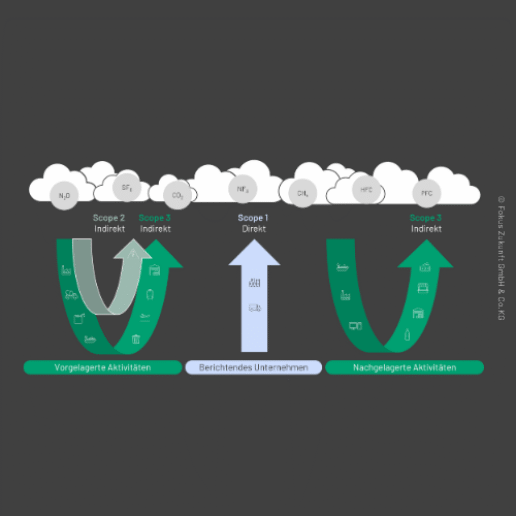
Dieser Grafik zeigt die Einteilung der Treibhausgasemissionen in Scopes
#Knowledge

An Overview of the Greenhouse Gas Protocol’s Scopes

The Greenhouse Gas Protocol provides a structure for measuring and comparing greenhouse gas emissions by dividing them into three so-called scopes. But what exactly do these scopes entail? And why is distinguishing between them so crucial for achieving genuine climate targets? The following blog article explores these questions in depth.
Read more
Climate strategy & accounting
#Interview

6 Questions for Christine Maderspacher on Climate and Emission Reduction Strategies

As part of our Climate Strategy Focus Month, we spoke with Christine Maderspacher. In this interview, she explains what is important for an effective climate strategy, what role energy efficiency plays in this, and how companies can systematically reduce emissions.
Read more
Climate strategy & accounting
Innovation & transformation
Headerbild für den Wissensbibliothek-Artikel "Was ist eine Klimastrategie und warum ist sie für Unternehmen jetzt wichtig?"
#Knowledge

Companies in Transition: Understanding Emissions, Developing Strategies, Securing the Future.

In our new blog article, you can find out why greenhouse gas accounting based on the Greenhouse Gas Protocol is often the starting point for corporate sustainability and how you can use it as a basis for successfully developing a decarbonization strategy.
Read more