#Interview
Climate strategy & accounting

6 Questions for Christine Madersbacher on Climate and Emission Reduction Strategies

Info about the article

Author
Christina Schäferkord, Christine Maderspacher
Article from
14.07.2025
Updated on
05.12.2025
Approximate reading time
minutes
Share article

“A climate strategy is not a one-off product that can be completed quickly, but rather a continuous process.”

As part of our focus month on climate strategy, we spoke with Christine Maderspacher, Senior Sustainability Consultant at Fokus Zukunft. She and her team support small and medium-sized enterprises on their path to implementing climate-conscious business practices, through CO₂ accounting, strategy development and concrete action planning. In this interview she explains what really matters in establishing an effective climate strategy, the important role energy efficiency plays, and how companies can systematically reduce emissions.

Many companies already have a rough idea of what climate protection entails. In your opinion, what makes a climate strategy truly effective and feasible?

The first step is always to analyze the current situation. This involves compiling figures and data from all areas of the company in order to derive their corresponding CO₂ emissions. This assessment serves as the basis for a climate strategy. It is therefore extremely important that the assessment is based on valid data and also includes all areas of the company. Only then can you get a meaningful picture of the biggest emission drivers and thus the areas with greatest potential for reducing CO₂ emissions in your business.

Once data is collected, the next step is to define savings targets and develop associated measures. It is important to think and act with a long-term perspective. A climate strategy is not a one-off product that can be completed quickly, but rather a continuous process.

Where is the greatest untapped potential for reducing emissions through energy efficiency in small and medium-sized enterprises?

That depends very much on the industry. The manufacturing sector often consumes enormous amounts of electricity or gas to operate its plants and machinery. That is where the potential for savings is naturally greatest. The quickest way to reduce emissions is to switch to green electricity. However, electricity consumption will still remain high and optimizing operations through energy efficiency can save significant amounts of energy, and therefore money.

The situation is often quite different for service companies. Here, business trips or employee commuting can account for a large proportion of the company’s emissions. In this case, it is necessary to raise awareness regarding the importance of employee commuting in order to bring about change.

Which external levers play a key role in the reduction strategy—for example, levers along the supply chain or in cooperation with partners?

In addition to emissions from energy and fuel consumption, we also analyze upstream and downstream processes and their emissions as part of our carbon footprint assessment—in other words, emissions that arise outside the company’s direct sphere of influence. These include logistics, purchased goods and services, and emissions resulting from the use and disposal of sold products. For many companies, collecting data for carbon footprint calculations is not easy and can be quite time-consuming. We support our customers in this area by implementing our pragmatic approach to data collection.

The insights gained from the carbon footprint assessment are very valuable. For example, key CO₂ drivers can be identified on individual logistics routes, in specific raw materials, or even in the disposal of certain products. If a company wants to analyze and optimize the emissions of its products even more precisely, we offer options for this too.

How does CO2 analysis work for products?

CO₂ emissions are analyzed throughout the product life cycle, through an analysis called the product carbon footprint (PCF). A complete PCF begins with raw material extraction and ends at product disposal (from cradle to grave). Depending on the issue or boundary conditions, only a partial analysis, e.g., only up to the factory gate, may be carried out. Depending on the product, it may also make sense to include its function. For the defined boundary, all data on material and energy flows are recorded and the corresponding CO₂ emissions are determined.

If a company wants to calculate product variants itself, an individual CO₂ calculator can even be created for this purpose. This is developed with your specific requirements and constraints in mind, and can be used both in product development and in communication with end customers.

What role does Fokus Zukunft play in this process? How does your team specifically support companies in this regard?

We are your constant companion and advisor throughout this process. We provide support right from the start by helping you define your goals and appropriate scope. Once it is clear which areas and categories of the company or product are to be considered, we help you collect the relevant data. Depending on the industry and size of the company, or even at the product level, this can be a real challenge. To address this, we provide practical advice and work with your company to find pragmatic approaches for the sometimes large and complex data volumes.
Once the assessment is complete, we analyze the results and make suggestions for further action. Sometimes, concrete indications of potential savings can already be derived and attacked at this stage through a jointly developed reduction strategy. We monitor success through regular re-assessments. In general, we are a constant point of contact for our customers for all questions relating to sustainability and climate protection, and we always try to find pragmatic and targeted solutions.

Further contributions

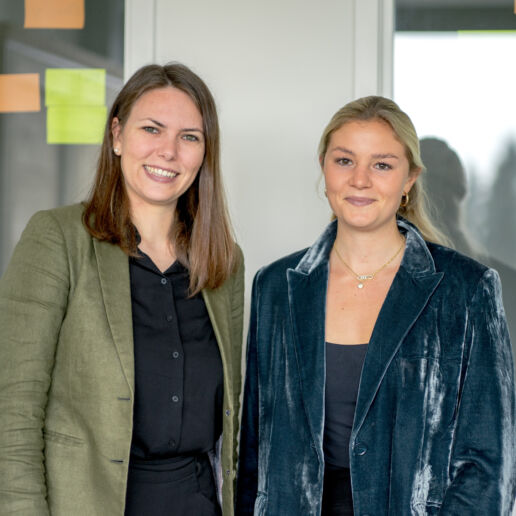
Bild der Fokus Zukunft Direktorinnen Janina Lang und Lena Scharr.
#Interview

10 Years of “Fokus Zukunft”: 5 Questions for Janina Lang & Lena Scharr

To mark the 10th anniversary of Fokus Zukunft, our directors, Janina Lang and Lena Scharr, discuss how sustainability has evolved, the milestones that have shaped the company, and what will be important in the future.
Read more
Communication & brand
Headerbild für den Wissensbibliothek-Artikel "CCF softwaregestützt erstellen: Unsere Partnerschaft mit Carbon+Alt+Delete"
#Knowledge

EmpCo Old Stock: Is There an Official Sell-Through Period?

What happens from 27 September 2026 to goods, packaging and labels that have already been produced and contain sustainability claims? The CPC Common Understanding provides guidance on how authorities should deal with genuine transitional situations and which measures companies should consider now.
Read more
Innovation & transformation
Headerbild für den Wissensbibliothek-Artikel "CCF softwaregestützt erstellen: Unsere Partnerschaft mit Carbon+Alt+Delete"
#Knowledge

Digital Product Passport: Creating the Right Conditions for Implementation Now

The Digital Product Passport is becoming a concrete reality – and for companies, preparation starts long before the passport itself. What matters is whether product data, responsibilities and processes are already set up effectively. Find out what is becoming important now and how companies can get started.
Read more
Communication & brand
Headerbild für den Wissensbibliothek-Artikel "Muss der Nachhaltigkeitsbericht Green Claims/EmpCo konform sein?"
#Knowledge

What EmpCo and the Swiss Unfair Competition Act (UWG) Mean for Companies

Many companies are no longer directly subject to CSRD reporting requirements due to the Omnibus package. But does that really mean sustainability reporting is losing relevance? This article shows why voluntary reporting creates orientation right now — for customer requests, banks, tenders and better internal decision-making.
Read more
Climate strategy & accounting
#Knowledge

Create your CCF with software support: Our partnership with Carbon+Alt+Delete

Fokus Zukunft is now a partner of Carbon+Alt+Delete. In our blog, we explain what the partnership is about, why we are expanding our services to include software-supported carbon accounting, and what benefits this creates for you.
Read more
Sustainability reporting
Headerbild für den Wissensbibliothek-Artikel "Nach dem Bericht - diese nächsten Schritte lohnen sich"
#Knowledge

After the report—these next steps are worth taking now

The sustainability report is complete—but what happens to the data that was collected? By analyzing it in a targeted manner, companies can identify concrete next steps: from climate strategy and product carbon footprints to EmpCo-compliant reporting, EcoVadis, and upcoming product requirements.
Read more
Sustainability reporting
Headerbild für den Wissensbibliothek-Artikel "Nachhaltigkeitsbericht fertig – und jetzt? Wie Nutzung echte Wirkung schafft"
#Knowledge

The Sustainability Report Is Complete—Now What? How Putting It to Use Makes a Real Difference

Published, filed away, forgotten? A sustainability report can achieve so much more. By using its content strategically, a company can strengthen its communication and sales efforts, respond more quickly to requirements, and make sustainability within the company measurable and open to further development.
Read more
Sustainability reporting
Communication & brand
#Knowledge

Why companies should take voluntary reporting seriously

Many companies are no longer directly subject to CSRD reporting requirements due to the Omnibus package. But does that really mean sustainability reporting is losing relevance? This article shows why voluntary reporting creates orientation right now — for customer requests, banks, tenders and better internal decision-making.
Read more
Sustainability reporting
Headerbild für den Wissensbibliothek-Artikel "Der neue VS-Standard"
#Knowledge

Voluntary Reporting: How to Get Off to a Pragmatic Start

Voluntary reporting doesn’t have to be a major undertaking. By avoiding common mistakes and starting with a clear structure, you can quickly establish a solid foundation for handling customer inquiries, dealing with banks, and providing internal guidance. This article shows you how to take a pragmatic approach to getting started with your reporting.
Read more
Sustainability reporting
Headerbild für den Wissensbibliothek-Artikel "Der neue VS-Standard"
#Knowledge

The New VS Standard

The new VS standard is intended to provide guidance going forward and better organize data requests from customers, banks, and business partners. Learn how it differs from the VSME and why companies should start familiarizing themselves with the new standard now.
Read more