How companies can compare investments in decarbonization measures, prioritize them effectively and account for economic risks
In many companies, decarbonization measures compete with other investments for limited capital. In the past, lower-carbon technologies were often associated with higher upfront investment or longer payback periods.
Today, this calculation is changing. In addition to investment and operating costs, energy prices, CO₂ costs, subsidies and regulatory developments increasingly influence which solution is economically viable in the long term. As a result, technologies may be financially attractive under conditions that differ significantly from just a few years ago.
For companies, it is therefore no longer sufficient to consider only technical feasibility or acquisition costs. What matters is how a measure performs over its entire useful life and under which conditions it becomes economically viable.
This requires several perspectives to be combined:
At the same time, regulatory developments such as CBAM and ETS II are changing the economic framework. Companies therefore need to consider not only which technology works from a technical perspective, but above all which investment remains economically viable under realistic assumptions about the future.
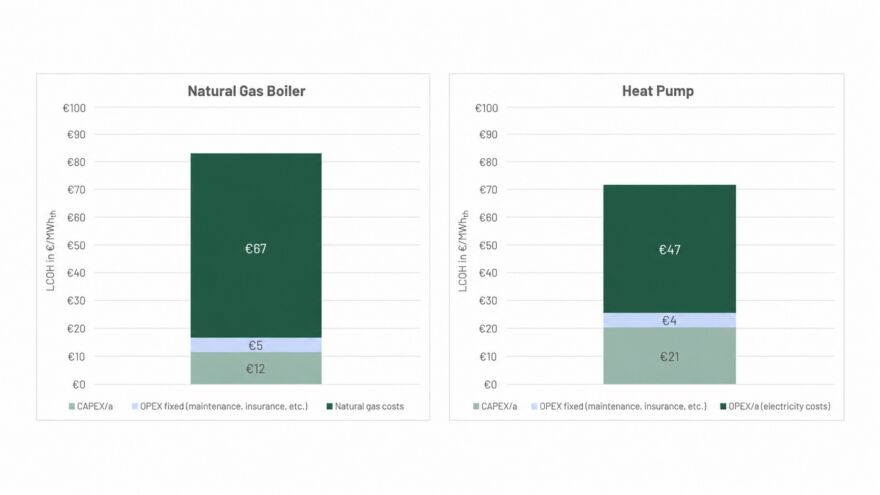
The Levelized Cost of Heat (LCOH) makes it possible to compare different heat generation pathways from an economic perspective. Instead of looking only at acquisition costs, the method considers costs over the entire lifetime of a solution.
It takes into account factors including investment costs, operating costs, subsidies, energy costs, utilization, efficiency and the cost of capital.
This is relevant, for example, when companies are choosing between a gas boiler, heat pump, biomass solution or district heating.
The key advantage is comparability: a technology with a higher upfront investment may prove more economical over its lifetime than an option that initially appears less expensive.
An LCOH analysis can show, for example, at what electricity or gas price a certain technology becomes financially attractive. At the same time, it illustrates how strongly full-load hours, subsidies or financing costs influence the result.
The analysis becomes particularly informative when combined with different CO₂ price scenarios. This makes it possible to determine at what CO₂ price a lower-emission solution also gains an economic advantage.
LCOH therefore provides more than a simple cost comparison. It helps companies assess investments over their entire useful life and place technology decisions on a more robust economic footing.
For energy-related investments, VALERI in accordance with DIN EN 17463 provides a structured methodology for assessing economic viability. Unlike a simple static payback calculation, the assessment is dynamic: among other things, it takes into account cash flows over the useful life of the investment, the timing of cash inflows and outflows, and additional economic assumptions.
This allows investments to be assessed in greater detail and presented transparently to management, controlling teams and technical decision-makers.
Companies with an average total final energy consumption of more than 2.5 GWh per year over the last three completed calendar years are required to prepare and publish implementation plans for final energy-saving measures identified as economically viable. For the assessment of economic viability, Section 9 of the German Energy Efficiency Act (EnEfG) explicitly refers to DIN EN 17463.
A measure is considered economically viable if, based on the assessment in accordance with DIN EN 17463, it achieves a positive net present value no later than 50 percent of its useful life. Useful lives of no more than 15 years are taken into account.
For companies, this means that VALERI is not simply a calculation method. It can also provide an important basis for prioritizing investments systematically and addressing regulatory requirements in a transparent way.
As carbon pricing expands, emissions are increasingly becoming a financial factor in investment decisions.
Under Germany’s national emissions trading system for fuels, a price corridor of EUR 55 to EUR 65 per certificate applies in 2026. Unlike in the years from 2021 to 2025, certificates are auctioned within this corridor in 2026.
For investment decisions, however, an individual CO₂ price is less important than the question of how costs may develop over the lifetime of an asset. Particularly for long-term investments, it therefore makes sense to calculate different CO₂ price scenarios. This shows how rising CO₂ costs may affect the operating costs of existing assets and under which conditions lower-emission alternatives become more economically attractive.
Internal carbon pricing: Factoring in CO₂ costs at an early stage
Companies can also integrate CO₂ costs into their decisions independently of regulatory carbon pricing. One option is to use an internal carbon price, for example in the form of a shadow price. This assigns a notional price to emissions, even if these costs do not yet arise in practice or do not arise at the same level.
This makes it possible to compare different investments or procurement options not only based on their direct costs, but also by taking their CO₂ impact into account. In supplier management, for example, an internal carbon price can help assess emissions-intensive procurement options from a more differentiated economic perspective and take potential future CO₂ costs into account at an early stage of the selection process.
In this way, CO₂ impact becomes an additional economic decision-making factor and can be integrated more systematically into existing investment and procurement processes.
Comparing measures across a portfolio
MAC curves – Marginal Abatement Cost Curves – extend this perspective by taking a portfolio view. They rank measures according to their cost per tonne of CO₂ avoided.
This can show, for example, which efficiency measures are already economically attractive at comparatively low CO₂ costs and which larger technology shifts only become viable at higher carbon prices.
Companies can use this information to prioritize more effectively: Which measures offer significant economic leverage? Which investments should be prepared at an early stage? And for which options might a later point in time be more economically appropriate?
MAC curves therefore help companies view decarbonization not as a collection of individual measures, but as an investment portfolio.
Regulatory developments are increasingly influencing the economic assumptions behind decarbonization projects. Two developments are particularly relevant in 2026.
CBAM has been in its definitive phase since 1 January 2026
The Carbon Border Adjustment Mechanism (CBAM) has been fully in force since 1 January 2026. Depending on the type and volume of goods imported, affected importers must act as authorised CBAM declarants, report the embedded emissions and surrender CBAM certificates.
Following the simplification of the system, a threshold of 50 tonnes per year generally applies to the mass-based CBAM product groups. Different rules apply to electricity and hydrogen.
The first CBAM declaration for imports made in 2026, together with the surrender of the corresponding certificates, is due by 30 September 2027.
CBAM can be relevant to business cases because carbon-intensive imports may result in additional costs. This can affect procurement decisions as well as the relative economics of domestic or lower-emission production.
Companies should therefore avoid viewing these costs solely as an additional regulatory burden. Instead, they should incorporate them into procurement, production and investment decisions at an early stage.
ETS II starts in 2028 instead of 2027
The new European emissions trading system for buildings, road transport and additional sectors, ETS II, was originally scheduled to start in 2027. EU Regulation 2026/667 postponed its operational start until 2028.
The regulatory framework for 2027 therefore remains in transition. Following the postponement of ETS II, the German Federal Government adopted a draft amendment to the Fuel Emissions Trading Act on 12 August 2026. The aim is to keep national carbon pricing stable in 2027.
For companies, the postponement primarily means a longer transition period. However, for investments made today in heating systems, vehicle fleets or other long-lived assets, potential CO₂ costs from 2028 onwards remain relevant. As long as future price developments cannot be predicted reliably, companies should therefore avoid calculating with a supposedly certain single price and instead model several scenarios.
For the economic viability of an investment, it is not only today’s CO₂ price that matters. Rising CO₂ costs may also be passed on to companies and end customers through higher prices for fossil energy sources. This changes the operating costs of existing assets – and therefore also the economics of lower-emission alternatives over their entire useful life.

A single metric is not sufficient to assess decarbonization investments reliably. A more meaningful approach is to use a decision-making process that combines technical, economic and regulatory factors.
This creates a decision-making basis that combines technology, finance and regulation. Companies can then assess not only whether a measure is economically viable, but also under which conditions, at what point in time and with what priority it makes sense to implement it.
Particularly for investments with long lifetimes, this approach provides greater transparency around costs, risks and potential economic benefits.
Decarbonization becomes easier to manage from an economic perspective when companies consider not only emissions, but also costs, risks and developments over time.
LCOH provides a robust cost basis for comparing heating technologies. VALERI structures the economic assessment of investments. MAC curves provide a portfolio perspective across different measures. Carbon pricing scenarios, in turn, translate potential regulatory developments into economic impacts.
2026 in particular demonstrates why it makes sense to work with scenarios rather than fixed assumptions: CBAM is in its definitive phase, ETS II has been postponed until 2028, and Germany’s national carbon pricing framework for 2027 is still moving through the legislative process.
By bringing these perspectives together, companies can assess decarbonization measures based on more than their climate impact alone. They can better understand which investments make economic sense, which risks they reduce and when the right time for implementation may be.
This turns decarbonization into a well-founded investment decision – and into an integral part of long-term economic development.