#Knowledge
Climate strategy & accounting
Create your CCF with software support:
Our partnership with Carbon+Alt+Delete
Our partnership with Carbon+Alt+Delete
For many companies, the Corporate Carbon Footprint (CCF) has long been more than a voluntary climate action measure. It provides transparency on a company’s greenhouse gas emissions and therefore forms an important basis for a well-founded climate strategy. At the same time, it helps companies meet customer and supplier requirements, prepare sustainability reports, and create a reliable basis for management decision-making.
Companies that understand their own emissions can identify key emission drivers, develop targeted reduction measures, and make progress measurable. At the same time, expectations from investors, business partners, and regulatory requirements are increasing. As a result, a robust carbon footprint is becoming an increasingly established standard.
There is no single approach that is right for every Corporate Carbon Footprint. Depending on a company’s size, complexity, and specific requirements, software-supported carbon accounting may be the most suitable option, while in other cases a more individually tailored calculation can offer clear advantages.
To make standardisable carbon accounting processes more efficient, we work with the Carbon+Alt+Delete software solution. Carbon+Alt+Delete supports the digitalisation of key steps in the carbon accounting process. Digital data collection, automated calculations, emission factors, and structured workflows can reduce the effort involved, particularly for recurring carbon footprints. This makes carbon accounting more efficient while ensuring that results remain transparent and auditable. The platform is based on recognised standards such as the Greenhouse Gas Protocol and supports the carbon accounting process from data collection through to reporting.
For us, the software is therefore an important component in making suitable carbon accounting projects more standardised and efficient in the future. At the same time, individually tailored carbon footprints remain an important part of our services wherever a company’s specific requirements call for them.
1. Faster and More Efficient Carbon Footprints
Digital data collection, automated calculations, and intelligent support in assigning emission factors simplify the creation and updating of carbon footprints.
For our clients, this means:
2. High Data Quality and Compliance
The platform is designed to enable transparent and auditable carbon accounting. It follows established standards such as the Greenhouse Gas Protocol and ISO 14064-1.
As a result, our clients benefit from:
3. Transparent Insights into Emission Drivers
A carbon footprint is particularly valuable when it leads to concrete opportunities for action. Carbon+Alt+Delete supports the systematic analysis of emission sources and helps identify the key drivers of a company’s emissions.
Our clients benefit from:
4. Support with Regulatory Requirements
Requirements for sustainability and climate reporting are continuing to increase. By systematically collecting and documenting relevant emissions data, we work with our clients to create a solid basis for future reporting obligations and sustainability requirements.
5. A Basis for Future-Proof Climate Strategies
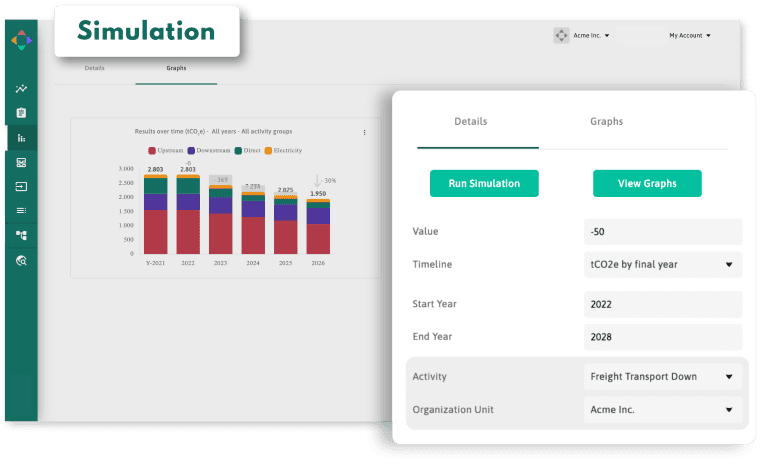
The platform not only supports emissions calculation, but also the development of scenarios and the identification of measures on the path towards net-zero targets.
As a result, our clients can:
Not every carbon footprint comes with the same requirements. That is why we work with our clients to determine which accounting approach best fits their specific situation.
Software-supported carbon accounting with Carbon+Alt+Delete is particularly suitable for companies that:
Our medium-sized clients with increasing reporting requirements benefit in particular. For recurring carbon footprints, standardised digital processes can also help reduce the workload over the long term.
At the same time, there are cases where an individually prepared carbon footprint remains the more suitable or necessary approach. This includes, for example, carbon footprints prepared in connection with BAFA funding or projects that require a high degree of customisation. In these cases, specific company structures and individual requirements can be taken into account more precisely. A professional software solution is also not always necessary for very small companies with only a few emission sources and limited documentation requirements. For these companies, we offer simplified calculation approaches.
Carbon+Alt+Delete expands the options available within our CCF accounting services. In software-supported projects, the platform handles large parts of the calculation logic and structures the carbon accounting process. We complement this with our expertise in sustainability strategy, decarbonisation, ESG management, and regulatory requirements. Where a higher degree of customisation is required, we continue to prepare carbon footprints using an appropriately adapted approach. This allows us to choose between standardised digital processes and individual accounting approaches depending on the specific situation.
For our clients, this means they do not simply receive a software solution, but a carbon accounting approach tailored to their requirements – combined with expert interpretation of the results and the identification of meaningful next steps.
Our partnership with Carbon+Alt+Delete complements our CCF services with an efficient, software-supported solution. At the same time, we continue to provide individually prepared carbon footprints for specific requirements, a high degree of customisation, or in connection with BAFA funding.
This allows us to select the carbon accounting approach that best fits the respective company and use case. Regardless of the chosen approach, the objective remains the same: to create a reliable data basis, identify key emission drivers, and enable well-founded decisions for the further development of the climate strategy.
Would you like to learn more about how Fokus Zukunft can support you with your CCF?